





Have you ever wondered how smartphones affect relationships when a husband and wife spend more time looking at their screens than looking at each other?
There is a strange third person sitting in millions of relationships today.
It does not sleep in the bedroom.
It does not sit at the dinner table by invitation.
It does not have a name.
It is the smartphone.
For many couples, the biggest problem in their relationship is not another person. It is not always money, family, work, or even a major disagreement. Sometimes, it is the small screen sitting between two people who once could not imagine their lives without each other.
A husband and wife can be sitting on the same couch, in the same room, eating the same dinner—and still be living in two completely different worlds because both are looking at their phones.
The problem is not that smartphones are automatically bad. They help us communicate, stay connected with family, work, learn new things, and find information within seconds. But the way we use them can slowly change how we communicate with the people closest to us.
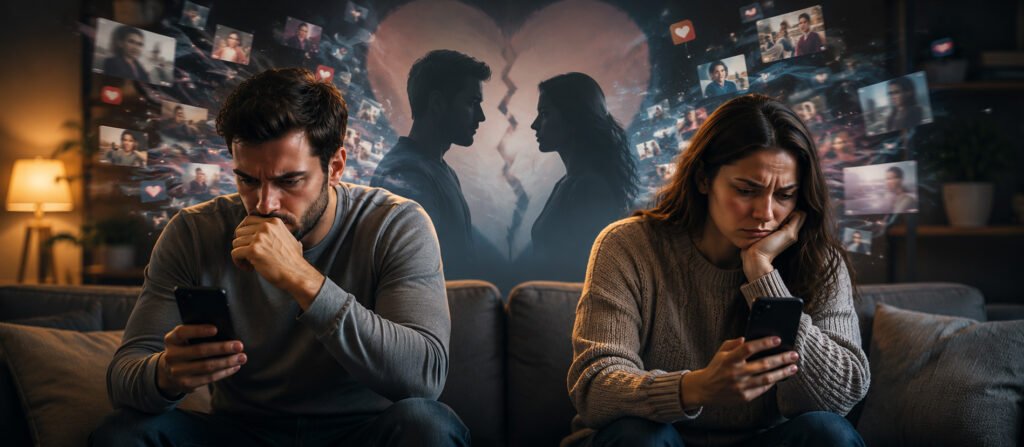
Social media makes this even more complicated. Personalized feeds can continue showing us content based on what we watch, search for, click on, and engage with. During a relationship conflict, this can sometimes create a cycle where each partner repeatedly sees content that confirms their own point of view.
A husband may see hundreds of posts about how wives do not respect their husbands.
A wife may see hundreds of posts about how husbands do not appreciate their wives.
Both may begin thinking, “See? I was right.”
And instead of bringing two people closer to a solution, the phone can make the disagreement even harder to resolve.
That is why understanding how smartphones affect relationships is becoming increasingly important for modern couples.
Your phone does not know your entire marriage.
It does not know the sacrifices you have made for each other, the difficult moments you survived together, the memories you share, or the reasons you fell in love.
But if you allow the screen to become louder than the person beside you, it can slowly influence how you see your relationship.
And sometimes, the first step toward protecting a relationship is surprisingly simple:
Put the phone down and listen to the person in front of you.
Your Phone May Be Showing You a Different Version of Your Relationship
One of the most confusing things about modern smartphones is how personalized our feeds have become.
You watch one video.
Then you watch another.
You stop scrolling on a particular topic.
You click on something.
You search for something.
You like, share, save or comment on content.
Over time, platforms can use these signals to recommend more content that appears relevant to your interests.
This can create an unusual situation inside a relationship.
Imagine a husband has an argument with his wife.
He feels hurt and believes his wife was wrong.
After the argument, he picks up his phone.
He watches a video about disrespectful wives.
Then another video about husbands being taken for granted.
Then another post about how men should “never apologize when they are right.”
The next morning, his feed may contain even more content around the same emotional theme.
He may start thinking:
“See? I was right.”
Now imagine the wife does exactly the same thing.
She is hurt too.
She searches for relationship advice.
She watches videos about emotionally unavailable husbands.
Then she sees posts about women who are not appreciated.
Her feed begins showing her more of the same message.
She thinks:
“See? I was right too.”
And now something important has happened.
The couple is no longer having one disagreement.
They are receiving thousands of tiny pieces of content that can reinforce their existing point of view.
That can make compromise much harder.
The Algorithm Does Not Know Your Marriage
This is an important point.
Your social-media feed does not know the complete story of your marriage.
It does not know what your husband did for you yesterday.
It does not know what your wife sacrificed last year.
It does not know how many times you helped each other through difficult moments.
It sees digital behavior.
It sees what you watch, interact with and spend time on.
That means a feed can become very good at showing you content that keeps your attention—but that does not necessarily mean it is showing you what is healthiest for your marriage.
A 20-second video can make you angry.
A 30-second relationship quote can make you feel validated.
A viral post can convince you that your partner’s normal mistake is a sign of a much bigger problem.
And when we are already angry, validation can feel better than understanding.
When Your Phone Becomes Your Relationship’s Echo Chamber
An echo chamber is an environment where we repeatedly encounter ideas that support what we already believe.
This can be especially dangerous during relationship conflict.
Suppose you believe:
“My husband never listens to me.”
You start watching content about emotionally unavailable husbands.
Soon you see hundreds of examples of husbands behaving badly.
You begin comparing your husband with those examples.
Every small mistake starts looking like evidence.
Now suppose your husband believes:
“My wife does not respect me.”
He starts watching content about disrespectful wives.
Again, he sees example after example supporting his belief.
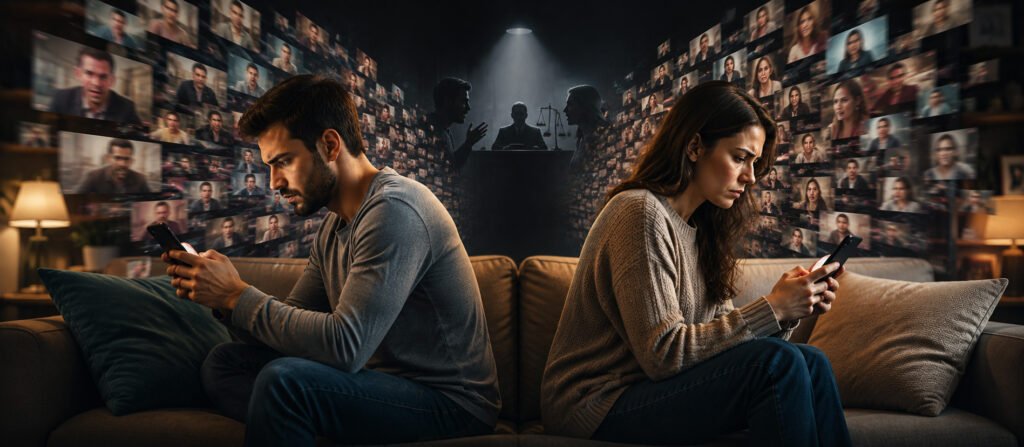
The two people who need to talk to each other are instead receiving separate streams of information that reinforce their individual positions.
The phone has quietly become a courtroom.
And every scroll feels like another piece of evidence.
Social Media Can Make You Compare Your Marriage to Someone Else’s Highlight Reel
Another major problem is comparison.
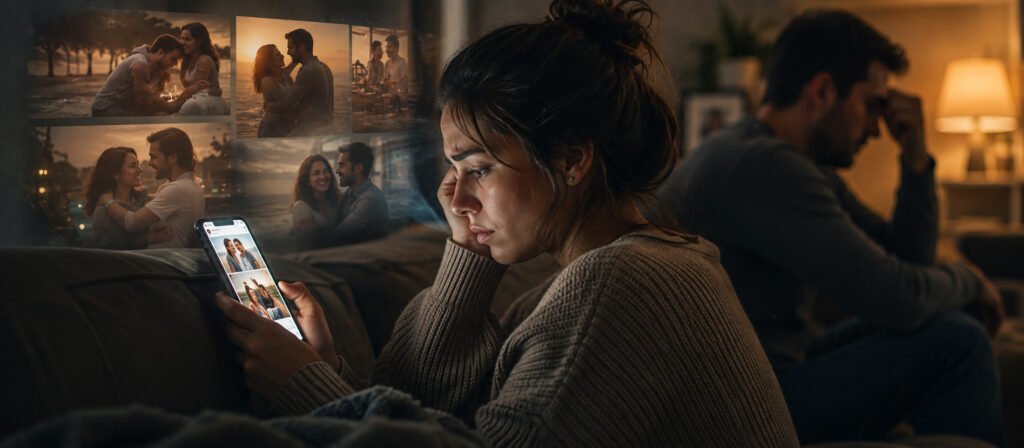
Social media makes it incredibly easy to look at other couples and think:
“Why don’t we have a relationship like that?”
You see couples traveling together.
You see husbands buying flowers.
You see wives surprising their husbands.
You see expensive dates.
Beautiful homes.
Anniversary gifts.
Romantic messages.
Perfect family photographs.
But social media usually shows moments—not the entire relationship.
You rarely see the argument that happened two hours earlier.
You do not see their financial stress.
You do not see their disagreements.
You do not see their private insecurities.
You do not see the days when they barely spoke.
You see the finished photograph.
Then you compare that photograph with your ordinary Tuesday night.
That is not a fair comparison.
Research on digital technology and relationships has repeatedly found that social-media use can become a source of jealousy, conflict and relationship dissatisfaction for some couples. Pew Research, for example, found that 23% of partnered social-media users said they had felt jealous or unsure about their relationship because of how their current partner interacted with others on social media.
The “Perfect Husband” and “Perfect Wife” Problem
Social media can also create unrealistic expectations.
A woman watches videos showing husbands who constantly buy gifts, write romantic messages and plan elaborate dates.
She begins thinking:
“Why doesn’t my husband do these things?”
A man watches videos showing wives who always look perfect, support everything their husbands do and never complain.
He begins thinking:
“Why isn’t my wife like that?”
Neither person realizes that they are comparing a real human being to edited content.
Real marriage is not a 30-second reel.
Real marriage includes tired mornings.
Bills.
Stress.
Children.
Work.
Illness.
Bad moods.
Misunderstandings.
Apologies.
Growth.
Forgiveness.
And ordinary days when nothing exciting happens.
A healthy relationship is not supposed to look like Instagram every day.
Phone Snubbing: When Your Partner Feels Less Important Than Your Screen
There is actually a term researchers use for a common smartphone behavior: partner phubbing.
It refers to paying attention to your phone while your romantic partner is present, making the partner feel ignored or pushed aside.
Research has associated partner phubbing with lower relationship satisfaction, and studies have explored smartphone conflict and feelings of exclusion and reduced intimacy.
Think about a simple situation.
Your wife is telling you about something important that happened at work.
You are looking at your phone.
You say:
“Yeah, I’m listening.”
But your eyes remain on the screen.
She continues talking.
You scroll.
Eventually, she stops.
Nothing dramatic happened.
Nobody screamed.
Nobody cheated.
Nobody left the house.
But she may have received a message:
“My phone is more interesting to him than I am.”
Repeat that moment every day for months and it can become much bigger than one ignored conversation.
The same thing can happen to husbands.
A husband may come home wanting to talk, but his wife is constantly checking notifications, watching videos or scrolling social media.
He may eventually stop trying to communicate.
And when communication disappears, emotional distance often grows with it.
The Phone Can Keep a Small Argument Alive
Healthy couples disagree.
Arguments are not automatically signs that a marriage is failing.
The problem is what happens after the disagreement.
In the past, a couple might argue, cool down, talk to a family member or friend, sleep on it, and eventually come back together.
Today, there is another option available every second:
Pick up the phone.
And the phone can provide endless validation.
You can search:
“Signs your husband does not love you.”
Or:
“Signs your wife is toxic.”
Or:
“How to know if your partner is narcissistic.”
Sometimes these searches can provide genuinely useful information.
But when used during anger, they can also turn a temporary disagreement into a permanent identity.
Instead of thinking:
“We had a bad argument.”
You start thinking:
“My husband is a bad husband.”
Instead of:
“My wife hurt me.”
You start thinking:
“My wife is toxic.”
That difference matters.
When you turn a behavior into a permanent label, forgiveness becomes much harder.

Are Smartphones Actually Causing Divorce?
This is where we need to be careful.
It would be inaccurate to say that smartphones alone are causing divorce.
Marriage breakdown is complicated.
Money problems, communication issues, infidelity, emotional disconnection, family conflict, abuse, incompatibility and many other factors can contribute.
However, research does suggest that digital technology can become one source of relationship conflict.
Studies have linked certain forms of social-media conflict and problematic online behaviors with negative relationship outcomes, while research on partner phubbing has found associations with lower relationship satisfaction and increased conflict.
In other words, the phone may not be the original problem.
But it can make an existing problem louder.
A small disagreement can become a two-hour argument after both partners spend time consuming content that confirms their own side.
A little insecurity can become jealousy after scrolling through social media.
A communication problem can become emotional distance when one partner repeatedly chooses a screen over conversation.
The phone can become an amplifier.
Why Social Media Can Be Especially Harmful During Marriage Problems
When people are emotionally upset, they often look for reassurance.
Social media can provide it instantly.
You can post anonymously.
You can watch strangers tell you that you deserve better.
You can read comments from thousands of people who know nothing about your marriage.
Some advice may be valuable.
But strangers online do not know your complete story.
They do not know your partner.
They were not present during your argument.
They do not know what happened before the argument.
And they certainly cannot see the entire history of your relationship through one post.
That is why couples should be careful about allowing internet opinions to become the final judge of their marriage.
When Comparison Starts Affecting Women and Men
Social-media comparison can affect anyone.
Women may compare their appearance, lifestyle, marriage, home, parenting and finances with what they see online.
Men can experience similar comparisons involving income, career success, fitness, possessions, relationships and expectations about masculinity.
The issue is not whether men or women are “more affected.”
The bigger issue is that people naturally compare their real lives with what they see.
And when the comparison happens every day, dissatisfaction can grow.
A person may have a perfectly normal marriage but constantly consume content showing extraordinary relationships.
Eventually, normal can start to feel inadequate.
Children Can Feel the Effects Too
There is another part of this problem that couples sometimes overlook:
their children are watching.
Children learn about relationships by observing adults.
If parents spend every evening looking at their phones, children learn that screens deserve attention.
If parents constantly argue about social media, children experience that tension.
If one parent is emotionally unavailable because of a phone, children may notice.
And when parents are constantly comparing themselves, fighting, withdrawing or criticizing each other, children can feel the emotional atmosphere even when nobody explains what is happening.
This does not mean every child whose parents use smartphones will experience relationship problems.
It means adults should recognize that their digital habits do not exist in isolation.
The way parents use technology can become part of the environment in which children grow up.
How to Stop Your Phone From Hurting Your Relationship
The good news is that couples do not need to throw their smartphones away.
They need boundaries.
1. Create a No-Phone Dinner Rule
Dinner should be about people, not notifications.
Put both phones away.
Even 30 minutes of uninterrupted conversation can make a difference.
2. Keep Phones Away During Serious Conversations
If your partner is discussing something emotional, put the phone down.
Look at them.
Listen.
Ask questions.
You do not need to solve everything immediately.
Sometimes your partner simply needs to feel heard.
3. Stop Searching for Evidence Against Your Partner
After an argument, do not immediately search for content that proves your partner is wrong.
Instead, ask:
“What part of this situation might I be misunderstanding?”
That one question can change the direction of an argument.
4. Be Careful With Relationship Advice on Social Media
Not every viral relationship quote is good advice.
A statement can receive millions of likes and still be completely wrong for your situation.
Use professional resources and qualified relationship counselors when serious problems need outside help.
5. Don’t Compare Your Marriage to Social Media Couples
Remember:
You are comparing your behind-the-scenes with someone else’s highlight reel.
Your marriage does not need to look like another couple’s marriage.
It needs to work for the two people living it.
6. Create a Daily Phone-Free Hour
Choose one hour every day where both partners put their phones away.
Talk.
Walk.
Cook together.
Play with your children.
Have coffee.
Or simply sit together.
The activity matters less than the attention.
7. Don’t Take Relationship Arguments to the Internet
Your marriage should not become public entertainment.
Before posting about your partner, ask yourself:
“Would I say this about my spouse if they were sitting beside me?”
If the answer is no, think carefully before posting it.
8. Pay Attention to What Your Feed Is Teaching You
This is one of the most overlooked steps.
Ask yourself:
“What kind of relationship content am I consuming every day?”
If your feed is filled with:
- toxic husband videos
- toxic wife videos
- cheating stories
- divorce content
- relationship rage
- gender-war content
- revenge advice
then it is worth asking why.
Your feed may be reflecting your interests.
But your interests can also be influenced by what the feed repeatedly puts in front of you.
Sometimes the healthiest decision is to stop feeding the algorithm with your anger.
Try a 7-Day Marriage Phone Reset
Couples who feel that smartphones are interfering with their relationship can try a simple seven-day experiment.
For one week:
No phones during meals.
No phones during serious conversations.
No relationship arguments through text when an in-person conversation is possible.
No checking social media while your partner is talking.
One phone-free hour together every day.
No searching for “proof” that your partner is wrong after an argument.
At the end of seven days, ask each other:
“Did you feel more connected to me this week?”
The goal is not to become anti-technology.
The goal is to remember that technology is supposed to serve your life—not replace it.
Your Partner Is Not Your Algorithm
This may be the most important lesson.
Your phone learns what keeps you watching.
Your partner needs to learn what makes you feel loved.
Those are two completely different things.
The algorithm wants your attention.
Your marriage needs your presence.
The algorithm benefits when you keep scrolling.
Your relationship benefits when you stop scrolling and start listening.
The algorithm does not care whether you forgive your spouse.
It does not care whether your family stays together.
It does not know the memories you share.
It does not know the promises you made.
It does not know how hard your partner worked to build your life together.
You do.
Before You Decide Your Marriage Is Broken, Put the Phone Down
The next time you have an argument with your husband or wife, try something different.
Don’t immediately reach for your phone.
Don’t search for a video that tells you how terrible your partner is.
Don’t compare your marriage to another couple.
Don’t let strangers on the internet become the judge of your relationship.
Put the phone down.
Take a breath.
Look at the person in front of you.
And ask:
“What are we actually fighting about?”
Sometimes the answer will be difficult.
Sometimes there may be serious problems that require professional help.
And sometimes the answer will be surprisingly simple:
Two people are hurt.
Two people feel misunderstood.
Two people want to be loved.
And two people have been listening to their phones more than they have been listening to each other.
Smartphones are not automatically destroying marriages.
But when a screen becomes more important than the person beside it, something needs to change.
Your phone can wait.
Your relationship deserves your attention.
Final Thought
We live in a world where a phone can show us thousands of opinions in a single day.
But your marriage does not need thousands of opinions.
It needs two people willing to listen.
Before the next notification takes your attention, remember the person sitting beside you.
They may be worth more than anything waiting on your screen.
Other Articles

Cottage Cheese Chocolate Mousse: Easy High-Protein Dessert
10 Best Personal AI Tools in 2026 for Everyday Life





[…] more entertainment and lifestyle coverage, readers can also explore our look at how smartphones affect relationships and our guide to practical AI tools for everyday […]
[…] How smartphones affect relationships and everyday life […]