





If your Google feed has suddenly filled with Google Pixel 11 in USA headlines, there is a good reason.
Google has just unveiled its new Pixel 11 lineup, putting its latest smartphone hardware and artificial intelligence features directly in front of U.S. consumers. The launch includes the Pixel 11, Pixel 11 Pro, Pixel 11 Pro XL and Pixel 11 Pro Fold, along with the Pixel Watch 5 and a new Pixel Tag tracking device.
The timing is important. The event landed just weeks before the next major iPhone cycle, giving Google a narrow but valuable window to convince consumers that the next smartphone upgrade should be a Pixel rather than an iPhone or another Android flagship.
And this year’s strategy is clear: Google is not simply selling a faster phone.
It is selling an AI-first smartphone experience.
That distinction could matter more than the processor, camera hardware or exterior design.
Why the Google Pixel 11 Is Suddenly So Interesting
Google’s Pixel launches have traditionally attracted Android enthusiasts, photographers and people who prefer Google’s version of Android. But the Pixel 11 arrives at a time when artificial intelligence has become one of the biggest selling points in consumer technology.
Google is pushing Gemini deeper into the phone experience, while new camera and notification features attempt to make the device feel more proactive rather than simply responsive.
The company’s latest phones also arrive with new hardware, including the Tensor G6 platform and updated camera systems. Google has introduced four primary Pixel 11 models, giving buyers several price and feature levels to choose from.
That makes the Pixel 11 more than another annual Android refresh.
It is Google’s latest attempt to define what an AI-powered phone should actually do for an ordinary person.
Google Pixel 11 Models: What Are the Options?
The new generation is split into four main smartphones.
| Model | Starting U.S. Price | Main Appeal |
|---|---|---|
| Pixel 11 | $899 | Standard flagship experience |
| Pixel 11 Pro | $1,099 | Premium camera and performance features |
| Pixel 11 Pro XL | $1,299 | Larger premium flagship |
| Pixel 11 Pro Fold | $1,899 | Foldable design and multitasking |
The pricing represents a noticeable step upward for Google’s flagship lineup. The base Pixel 11 starts at $899, while the Pro models move into increasingly premium territory. The Pixel 11 Pro Fold sits firmly in the ultra-premium category at $1,899.
That pricing immediately creates an important question:
Does the Pixel 11 offer enough new technology to justify the higher cost?
The answer depends heavily on what you expect from your phone.
Pixel 11 AI Features Could Be Its Biggest Advantage
The most important story surrounding the Pixel 11 isn’t necessarily the screen or processor.
It is artificial intelligence.
Google has been building Gemini into its ecosystem for some time, but the Pixel 11 generation pushes that relationship further. The company is positioning AI as part of everyday phone interaction rather than something users open as a separate application.
That could change how people think about smartphone upgrades.
Instead of asking whether the phone has a faster processor, buyers may increasingly ask:
- Can it understand what I am doing?
- Can it help me organize information?
- Can it translate conversations?
- Can it improve my photos automatically?
- Can it understand speech more accurately?
- Can it complete tasks with fewer steps?
Those are the questions Google’s Pixel strategy is increasingly designed to answer.
The new devices include features involving real-time translation, AI-assisted photography and more proactive Gemini functionality.
For consumers already comfortable with AI assistants, this could make the Pixel 11 feel significantly more useful than a conventional hardware upgrade.
Gemini Is Becoming More Central to the Pixel Experience
Google has one major advantage in the AI smartphone race: it controls both a huge AI ecosystem and the Android platform.
That means Gemini can potentially interact with more parts of the phone than a standalone chatbot.
For users, the attraction is simple.
Imagine being able to ask your phone to help understand a conversation, summarize information, work with content on the device or assist with planning without constantly jumping between applications.
Google’s strategy appears to be moving toward that type of interaction.
The Pixel 11 therefore represents an important experiment in smartphone design: what happens when AI becomes part of the operating experience instead of merely another app?
Whether consumers actually use these features every day will ultimately determine whether Google’s approach succeeds.
Pixel 11 Camera: Google Focuses on AI Photography
Google’s Pixel phones have developed a strong reputation for computational photography, and the Pixel 11 continues that approach.
The new generation brings upgraded camera capabilities and AI-powered photography tools. One of the highlighted features is Magic Capture, designed to make it easier to capture useful moments from photos and video. Google is also promoting enhanced zoom and stabilization capabilities on its Pro models.
The bigger trend here is obvious.
Smartphone cameras are no longer competing purely on megapixels.
The competition is increasingly about what software can do after the image is captured.
What Pixel 11 Camera Buyers Should Care About
For everyday users, the most meaningful improvements may include:
- Better computational photography
- Improved stabilization
- More advanced AI editing
- Enhanced zoom capabilities
- Smarter video capture
- Better speech-to-text functionality
- AI-assisted photo and video processing
Google is particularly strong when it combines camera hardware with machine-learning processing.
That means the real Pixel 11 camera experience cannot be judged simply by looking at a specification sheet.
The question is whether the finished photograph or video looks better.
The New HiLight Feature Is One of Pixel 11’s Most Noticeable Changes
One of the more unusual additions to the Pixel 11 family is HiLight, an illuminated feature integrated into the phone’s design.
Google is using it for visual notifications and AI-related interactions, creating a more physical way for the phone to communicate information.
It is an interesting idea because smartphones have become increasingly screen-dependent.
Instead of turning on the display every time something happens, a small visual indicator can communicate that something needs attention.
The feature has already generated mixed reactions among early Pixel discussions, with some users seeing it as a clever addition and others questioning how useful it will be in everyday life.
That debate is actually healthy for Google’s new feature.
A technology does not become useful simply because it is new.
The real test will be whether people continue using HiLight after the novelty disappears.
Tensor G6: Google’s Next Step for Pixel Performance
The Pixel 11 series is built around Google’s new Tensor G6 platform.
Google’s Tensor chips have never been marketed solely around traditional benchmark performance. Their bigger purpose has been to power Google’s machine-learning features directly on the phone.
That philosophy continues with the Pixel 11.
The company is connecting hardware performance with AI capabilities, photography, translation and other intelligent functions.
For most consumers, that means the important question isn’t necessarily whether Tensor G6 beats every competing chip in a benchmark.
It is whether the phone feels fast, reliable and intelligent during normal use.
The Pixel 11 also starts its storage lineup at 256GB, removing the previous 128GB entry point according to reporting from the launch.
For people who keep large photo libraries, download games or record lots of video, that change could be more useful than an incremental benchmark improvement.
Pixel 11 Pro and Pro XL Are Designed for Serious Smartphone Buyers
The Pixel 11 Pro and Pixel 11 Pro XL are aimed at consumers who want Google’s best camera and hardware experience.
The Pro models bring more advanced camera capabilities, larger configurations and premium features that aren’t intended to compete solely on price.
The Pro XL takes the same premium approach but gives buyers a larger phone.
That creates a familiar choice:
Do you want maximum portability, or do you want the biggest screen and battery-oriented flagship experience?
For people who regularly edit photos, watch video, play games or work from their phones, the larger Pro XL may be more attractive.
For everyone else, the standard Pro could represent the better balance.
Pixel 11 Pro Fold Takes Google Into a Different Smartphone Market
The Pixel 11 Pro Fold is arguably the most interesting hardware product in the lineup.
At $1,899, it is expensive, but the device is aimed at a completely different type of buyer.
Foldable phones are increasingly positioned as miniature productivity machines.
When opened, a large flexible display provides more room for multitasking, documents, media and creative work.
Google is also making the new foldable thinner and lighter than its predecessor while improving the display and camera system.
For someone who wants a phone and compact tablet-like experience in one device, the Pixel 11 Pro Fold could be the most compelling model.
For everyone else, the standard Pixel 11 family is likely to make more financial sense.
Pixel Watch 5 and Pixel Tag Expand Google’s Hardware Strategy
The Pixel 11 launch wasn’t limited to smartphones.
Google also introduced the Pixel Watch 5 and Pixel Tag.
The Pixel Watch 5 adds new health and fitness-oriented capabilities, while Google’s Pixel Tag enters the growing Bluetooth tracker market dominated by products such as Apple’s AirTag.
The Pixel Tag is particularly interesting because it expands Google’s hardware ecosystem beyond phones and watches.
According to launch coverage, the device is priced at $29 and works with Android devices through Google’s Find Hub network. It also includes ultra-wideband support and a built-in speaker.
That gives Google another way to make its hardware ecosystem more attractive.
The more devices consumers connect to one ecosystem, the harder it becomes to switch platforms.
Apple has understood this for years.
Google appears increasingly determined to build its own version of that ecosystem.
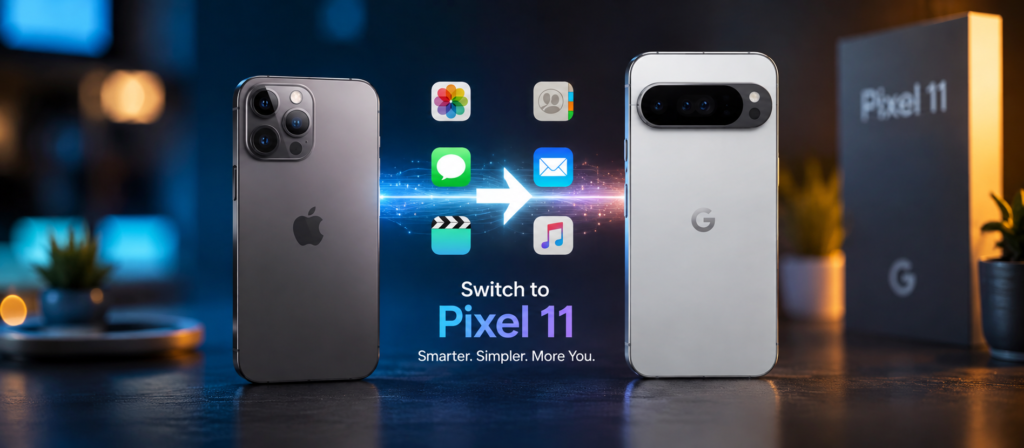
Pixel 11 vs iPhone: Google’s Biggest Challenge
There is an obvious competitor hanging over every Pixel 11 discussion.
The iPhone.
Google has a strong Android platform and increasingly sophisticated AI technology, but Apple retains enormous consumer loyalty in the U.S.
The Pixel 11 therefore has to offer something more compelling than a list of specifications.
It needs to give consumers a reason to change.
Google’s strongest argument is AI.
Apple’s strongest advantage remains ecosystem loyalty and the familiarity of the iPhone experience.
That makes the next few months particularly interesting.
Apple is expected to put significant attention on its own AI and Siri improvements, while Google is already presenting Gemini as a central part of its phone strategy.
The competition is no longer simply:
Android vs. iPhone.
It is increasingly:
Which company’s AI becomes the most useful part of your daily life?
Is the Google Pixel 11 Worth Upgrading To?
This is where the Pixel 11 story becomes more complicated.
If you own an older Pixel phone, the upgrade could be substantial.
If you already own a recent flagship, however, the decision is harder.
The new Pixel 11 generation offers meaningful improvements in AI, cameras, software integration and hardware. But some early community reactions have criticized the higher pricing and questioned whether the generational changes are large enough for owners of recent Pixel devices.
That doesn’t mean the Pixel 11 is a bad phone.
It means the upgrade equation has changed.
The Pixel 11 Makes More Sense If You:
- Own an older Android phone
- Want Google’s version of Android
- Care strongly about AI features
- Take lots of photos and videos
- Want Google’s latest camera technology
- Are interested in the Pixel ecosystem
- Want a long-term flagship device
- Are switching from an older iPhone or Android model
You May Want to Wait If You:
- Already own a recent Pixel flagship
- Are happy with your current camera
- Don’t use AI features
- Primarily care about gaming performance
- Think the higher price is difficult to justify
- Prefer Apple’s ecosystem
- Don’t need a new phone right now
Pixel 11 Pricing Could Be Google’s Biggest Problem
Technology companies increasingly face a difficult balancing act.
Consumers want better technology, but they are also becoming more careful about spending.
The Pixel 11 starts at $899, which places it firmly in premium smartphone territory. The Pixel 11 Pro starts at $1,099, while the Pro XL starts at $1,299. The foldable reaches $1,899.
Those prices make trade-in promotions extremely important.
Google and U.S. carriers are already using promotional offers to reduce the effective cost for eligible customers. Launch promotions reported by retailers and carriers include trade-in incentives and gift-card offers.
For American consumers, the headline price therefore may not tell the whole story.
The real question is:
How much will the Pixel 11 cost after trade-in, carrier credits and launch promotions?
That could determine whether the phone feels expensive or surprisingly competitive.
The Bigger Story: Google Wants AI to Sell Phones
This may ultimately be the most important takeaway from the Pixel 11 launch.
For years, smartphone companies sold upgrades through hardware.
A better camera.
A faster processor.
A brighter screen.
A bigger battery.
Google is increasingly trying to sell something different:
intelligence.
The company wants consumers to believe that the next smartphone isn’t simply a better piece of hardware.
It is a more capable assistant.
That strategy makes sense because traditional smartphone innovation has become increasingly incremental.
The average consumer may struggle to notice a modest processor improvement.
They can, however, immediately understand the value of a phone that translates a conversation, improves a difficult photo or helps organize information.
That’s why the Pixel 11 matters beyond Google’s own product lineup.
It represents another step toward the AI-native smartphone.
What U.S. Buyers Should Watch Before Ordering
The launch excitement is real, but smart buyers should still slow down before spending $899 or more.
Look at five things first.
1. Compare Trade-In Offers
The difference between Google’s direct price and a carrier promotion can be substantial.
2. Check Your Current Phone
If your existing Pixel is only one generation old, the upgrade may not be urgent.
3. Test the AI Features
Don’t buy an AI phone simply because the word “AI” appears repeatedly in the marketing.
Consider which features you would actually use.
4. Compare the Camera Results
Camera specifications tell only part of the story. Real-world samples matter more.
5. Consider the Entire Ecosystem
If you already own an Apple Watch, Mac and iPhone, moving to Pixel involves more than replacing one device.
Likewise, existing Android users may find the Pixel ecosystem much easier to adopt.
Final Verdict: Pixel 11 Is More Important Than It Looks
The Google Pixel 11 is not necessarily a revolution in smartphone hardware.
And that may be exactly the point.
Google appears to be betting that the next major smartphone battle will happen through artificial intelligence rather than dramatic physical redesigns.
The new Pixel family combines upgraded cameras, Tensor G6 hardware, deeper Gemini integration, new visual interaction features and a growing collection of connected devices.
For U.S. buyers looking for a new Android flagship, the Pixel 11 deserves serious attention.
For owners of recent Pixel phones, however, the decision is less obvious.
The strongest reason to upgrade isn’t simply that the Pixel 11 is newer.
It is that Google is trying to make the phone smarter.
Whether that makes the Pixel 11 worth the higher price will depend on one thing more than anything else:
How useful Google’s AI becomes once the launch excitement wears off.
And that is the real story to watch as the Pixel 11 begins reaching customers in the United States.
Key Takeaways
- Google has launched the Pixel 11, Pixel 11 Pro, Pixel 11 Pro XL and Pixel 11 Pro Fold.
- The U.S. starting prices range from $899 for the Pixel 11 to $1,899 for the Pro Fold.
- AI and Gemini are central to Google’s Pixel 11 strategy.
- Tensor G6 powers the new generation.
- Camera improvements and AI photography remain major selling points.
- HiLight introduces a new visual notification concept.
- Google also launched the Pixel Watch 5 and Pixel Tag.
- Recent Pixel owners may have fewer reasons to upgrade immediately.
- Trade-in and carrier promotions could significantly change the effective purchase price.
- The Pixel 11’s biggest long-term advantage could be Google’s AI ecosystem rather than its hardware alone.
FAQs
Is the Google Pixel 11 available in the U.S.?
Yes. Google has launched the Pixel 11 series for the U.S. market, with preorders opening alongside the launch. Shipping is reported to begin August 20, 2026.
How much does the Google Pixel 11 cost?
The Pixel 11 starts at $899 in the United States. The Pixel 11 Pro starts at $1,099, the Pixel 11 Pro XL at $1,299 and the Pixel 11 Pro Fold at $1,899.
What is the biggest Pixel 11 upgrade?
Google is emphasizing AI, Gemini integration, camera improvements and the new Tensor G6 platform rather than relying on a dramatic redesign.
Does the Pixel 11 have Gemini AI?
Yes. Gemini is deeply integrated into the Pixel 11 experience, with Google highlighting AI-assisted functionality including translation and intelligent assistance.
Is the Pixel 11 worth upgrading from a Pixel 10?
It depends. Users who prioritize Google’s newest AI and camera features may find the upgrade worthwhile, while owners of recent Pixel models may prefer to wait for a larger generational change.
What is the Pixel 11 Pro Fold?
The Pixel 11 Pro Fold is Google’s premium foldable smartphone. It starts at $1,899 in the U.S. and is designed for buyers who want a larger foldable display and multitasking capabilities.
What is Pixel Tag?
Pixel Tag is Google’s new tracking device designed to help users locate belongings through Google’s Find Hub ecosystem. It is priced at $29 according to launch coverage.
Should iPhone users switch to Pixel 11?
It depends on ecosystem preferences. Users who want Google’s AI features and Android experience may find the Pixel attractive, but people heavily invested in Apple’s hardware and services should consider the switching costs before moving.
Other Articles

Spider-Man: Brand New Day Review (2026): Tom Holland Returns

[…] Google Pixel 11 and what U.S. smartphone buyers should know […]