





Amazon Prime Big Deal Days 2026 runs October 6–7 in the United States, starting at 12:01 a.m. Pacific Daylight Time on October 6. Amazon says the 48-hour fall shopping event will feature millions of deals exclusively for Prime members. New “Today’s Big Deals” drops are scheduled three times daily, at midnight, 8 a.m., and 1 p.m. PDT, while supplies last. This guide separates the confirmed announcement from practical steps shoppers can take before a sale price appears.
Amazon announced the dates September 14. The company has named broad categories and examples of early offers, but individual prices and inventory may change. We have not verified any item as the “best” deal for you. Treat a percentage discount as a starting point and compare the actual final cost with your budget and price history.
Prime Big Deal Days 2026: dates, start time, and eligibility
The US event begins Tuesday, October 6 at 12:01 a.m. PDT and continues through Wednesday, October 7. That opening time is 3:01 a.m. Eastern Daylight Time. The event spans 48 hours, but individual offers may begin later, expire earlier, or run out. Amazon says “Today’s Big Deals” launch at midnight, 8 a.m., and 1 p.m. PDT on each event day.
The headline deals are for Prime members. Amazon advertises an eligible 30-day Prime trial; terms and eligibility matter. If you would subscribe only for one purchase, calculate the membership cost after any trial and set a reminder to review it. Never assume a trial is available for every account. A product may also be discounted outside the event, so check the actual offer page.
Amazon says the event extends to 22 countries, including Canada and the UK, but dates may vary by country. This article covers the US announcement, US time zones, and US offers. International readers should confirm the dates and eligibility on their local Amazon storefront rather than applying an American promotion to their own region.
What categories has Amazon announced?
Amazon’s press release highlights fall apparel and shoes, bedding, blankets, holiday décor, game-day hosting supplies, Halloween costumes, toys, electronics, beauty, kitchen items, and household essentials. The retailer cites up to 45% off select fall apparel and shoes, up to 35% off some bedding and décor, and up to 30% off select hosting gear. “Up to” refers to some qualifying items; it does not promise that every item in a category will receive that reduction.
Named brands in the announcement include Sony, adidas, Tarte, Caraway, Canon, LEGO, Dyson, Shark, and Soundcore, among others. Brand inclusion does not identify a particular model’s lowest price or guarantee a discount on everything the brand sells. Always check the exact model number, size, color, seller, condition, and return terms.
Amazon also mentions select deals on its own devices and bundles, books, household staples, and music-related offers. Some promotions are already available before October 6, while others are timed for the sale. Prices shown in an announcement are time-sensitive marketing examples, not a standing price list; confirm each listing on the day you buy.
How to prepare a useful shopping list
Begin with needs, not a sale banner. Make three columns: must buy soon, would buy at a sensible price, and interesting but unnecessary. For each item, record the exact model or specification and the maximum all-in amount you are willing to pay. That cap should include sales tax, shipping, accessories, and any subscription or warranty you plan to purchase.
For electronics, verify storage, screen size, generation, connectors, included accessories, and retailer warranty. A discounted older model can be a good purchase if it meets your needs, but a similar product name can hide a different configuration. Our smartphone buying guide explains how to compare specifications before buying. Do not mistake a bundle discount for a lower standalone-device price.
For apparel, note your measurements and check whether a promotional color or size is the one you need. For toys, match age guidance and delivery timing. For consumables, compare the price per ounce, count, or use rather than package size. A giant multipack is only a saving if you will use it before it expires or deteriorates.
Keep the list short. If ten items are equally urgent, a quick checkout becomes a research project during the most crowded part of the sale. Research expensive products now, then let the event answer only one question: is the final offer below your already chosen threshold?
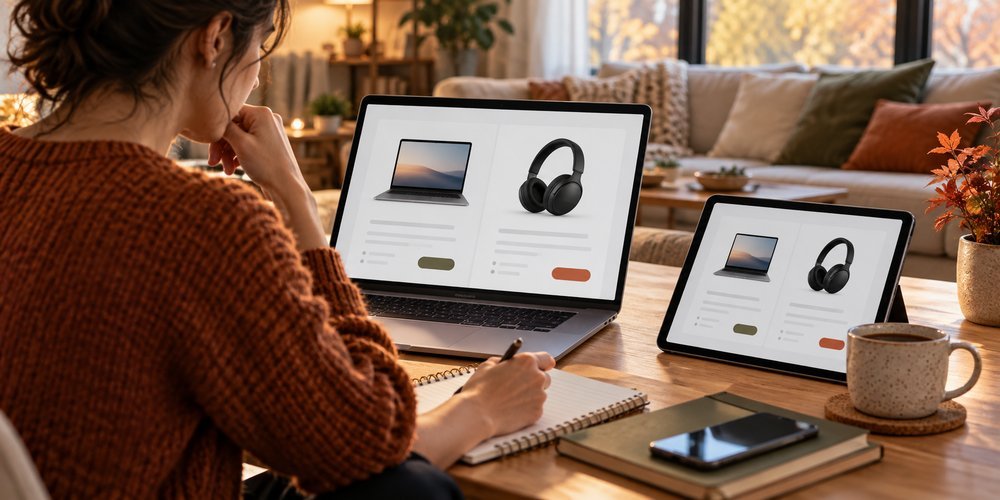
Use price history, but read it carefully
Amazon says its Alexa for Shopping tools can show up to 365 days of pricing insights on many product pages and let shoppers set deal alerts. Availability can vary by product and account. Look for a price history link or other reliable history information when shopping, and check whether it refers to the exact variant and seller you plan to buy.
A price that fell from a high recent list price may still be higher than a normal sale price last month. Compare the current amount with several weeks or months of ordinary prices when possible. If a history chart is incomplete, consider checking the manufacturer’s store and other reputable US retailers for the same model. Do not treat a crossed-out reference price as an independent measure of value.
Read any coupon or card offer conditions. Some extra savings require a specific payment method, first-time redemption, a minimum purchase, or a limited date window. Compare the final checkout amount rather than stacking advertised percentages in your head. A deal that requires opening a financial product deserves a separate decision from the purchase itself.
Deal alerts and timed drops
Amazon says shoppers can ask Alexa for Shopping to alert them to specific products or categories and can use lists to surface discounts on saved items. A targeted alert for a named product is more useful than a broad alert for “electronics.” The company also describes a target-price and Auto-Buy option on eligible items. If you use automatic purchasing, review the exact product, size, seller, and spending limit before turning it on.
The three announced daily drop times are useful planning markers, but they do not mean the whole event requires constant monitoring. Check at a time that fits your schedule. A limited-quantity offer may sell out, yet urgency alone is not evidence of value. If an item misses your price threshold, let it go.
For household basics, buy quantities you would ordinarily use. A “stock-up” promotion can tie up cash and storage space. For gifts, check the recipient’s preferences and the retailer’s return window before buying months ahead of the occasion. Keep receipts and order details in case the wrong variant arrives.
Prime membership and trials: calculate the real cost
Amazon says eligible customers can start a 30-day Prime trial to participate. It also describes separate programs for young adults and some qualifying customers. Eligibility, introductory periods, recurring charges, and benefits can change, so consult the current membership terms before enrollment.
A simple calculation is useful: expected savings on items you were already going to buy minus any membership cost you would otherwise avoid. If that number is small, a normal retailer promotion may be just as good. Delivery convenience and entertainment benefits may matter to some households, but count them only if you will actually use them.
Do not open or renew a membership solely because the event claims “millions” of deals. Your basket is usually a handful of specific products. Check those products before and during the event, and compare the final result against the price you were already willing to pay.
Where early offers may make sense
Amazon’s announcement lists early promotions on select Amazon-branded goods, devices, books, and other categories. If an exact item on your list is already below your threshold and you need it soon, waiting for the event is a gamble: the price could improve, remain similar, or rise, and stock can change. Consider the return terms and any price adjustment policy rather than assuming the retailer will refund the difference.
For a nonurgent purchase, wait and compare. Save a screenshot or note of the current price and seller. On October 6 or 7, confirm you are viewing the same configuration. Some sellers change bundles or packaging, which can make two prices look comparable when they are not.
Holiday shopping months in advance may be useful for a known gift, but verify storage, shelf life, warranties, and return deadlines. Electronic warranties may begin around purchase rather than the day someone opens the box. Read the product terms for your specific item.
Watch out for misleading sale signals
A badge reading “deal” does not guarantee the lowest price of the year. The announcement itself refers to many items reaching their lowest Amazon price so far this year, which is a different claim from lowest price at any retailer or lowest future price. Evaluate the offer in context.
Ratings deserve the same care. A listing may group reviews from several variations, colors, or generations. Sort recent feedback and look at the exact model. For third-party sellers, review seller details, delivery estimate, returns, and product condition. A seemingly cheaper imported or refurbished listing may not be equivalent to a new US-warranty item.
Be cautious with messages promising secret early access or asking you to enter account credentials outside the normal app or site. Navigate to Amazon yourself rather than following an unexpected link. For a high-value purchase, use a payment method and account settings you trust, and preserve order confirmation.
Delivery, returns, and the checkout screen
Amazon advertises fast delivery in many US locations, but availability depends on address, product, seller, and order timing. A “same-day” banner for one ZIP code may not apply to another. Check the actual estimated delivery date at checkout, particularly for Halloween costumes or a time-sensitive gift.
Compare the final amount after taxes and any delivery charges. For marketplace listings, verify whether the item is sold by Amazon, fulfilled by Amazon, or sold and shipped by another merchant. Those details may affect service and return steps. Read the return policy and note the deadline when buying seasonal merchandise.
If you purchase several variants to compare, consider the time and return shipping involved. A good price can become less compelling if a complicated return is likely. Measure first, check compatibility, and order the configuration you intend to keep.
Should you shop immediately at the event opening?
Only if your chosen product is in a limited offer and you know its fair price. The event begins shortly after midnight Pacific time, but daily drops also occur at later announced times. Many shoppers can compare offers in the morning without turning a two-day event into a sleepless race.
Plan a ten-minute check: open your short list, compare exact item prices against your threshold, check coupons and shipping, and purchase only the products that pass. A second check later can catch a new drop. A countdown timer should not override an informed decision.
Frequently asked questions
When is Amazon Prime Big Deal Days 2026?
October 6–7 in the US. Amazon says it starts at 12:01 a.m. PDT on October 6, equivalent to 3:01 a.m. EDT.
Is Prime membership required?
Amazon describes the event’s millions of deals as exclusive to Prime members. Some regular or early offers may exist outside membership; check the exact listing and terms. Trial eligibility varies by account.
Are the same deals available in Canada or the UK?
Amazon says the event reaches 22 countries including Canada and the UK, but dates may vary. Local product selection, currencies, terms, and pricing can differ. Use the storefront for your country.
Will every advertised brand be discounted?
No such blanket promise appears in the announcement. Amazon cites brands and select offers, and inventory can change. Search the exact product before assuming its price will fall.
What is the best category to shop?
The answer depends on your own list and price history. Amazon highlights apparel, home, toys, technology, and seasonal goods. The best deal is an item you need, from a suitable seller, below a verified fair price.
Our take
Prime Big Deal Days is a useful opportunity to compare fall and holiday purchases, especially if you already have a Prime membership. The event’s scale is less useful than a short, researched list. Set price limits now, check exact configurations and seller terms, then make a calm decision when the offers appear on October 6–7.
Source and timing: Amazon’s September 14, 2026 announcement, reviewed September 24. Deal examples are retailer claims and may change; we have not independently tested individual discounts. This article contains no affiliate product links.
Other Articles

When to Get a Flu Shot in 2026: US Guide to the 2026–27 Season





[…] Amazon Prime Big Deal Days 2026: Dates, Deals and How to Shop Smart […]