





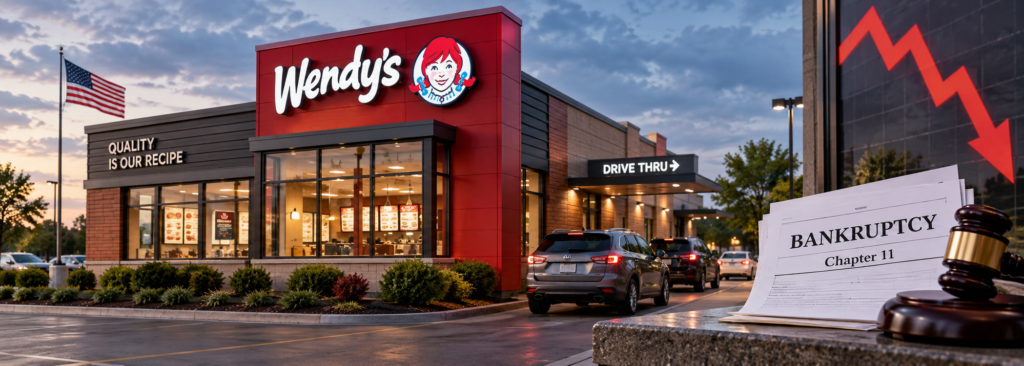
Wendy’s franchisee bankruptcy news is drawing attention across the United States after one of the chain’s largest operators filed for Chapter 11 protection. The case puts a new spotlight on the financial pressures facing the fast-food business in 2026.
Meritage Hospitality Group, a Michigan-based restaurant operator, filed for bankruptcy protection on September 17. The company operates 314 Wendy’s restaurants across 15 states and employs roughly 9,000 people. Despite the filing, Meritage has said it intends to keep its restaurants operating while it restructures its finances.
That distinction matters. The filing does not mean Wendy’s itself has filed for bankruptcy, nor does it mean all 314 restaurants are immediately closing. Instead, one of the chain’s largest franchisees is using Chapter 11 to reorganize while dealing with debt, weaker restaurant economics, higher costs and a dispute with Wendy’s.
For American consumers, the bigger question is obvious: What happens to Wendy’s restaurants now? The answer reveals a larger story about rising food costs, price-sensitive customers and the increasingly difficult economics facing some U.S. restaurant franchisees.
Wendy’s Franchisee Bankruptcy: What Happened?
Meritage Hospitality Group filed for Chapter 11 bankruptcy protection in the U.S. Bankruptcy Court for the Western District of Michigan on September 17, 2026.
The scale of the company makes the filing particularly significant. Meritage operates 314 Wendy’s locations in 15 states, representing roughly 5% of Wendy’s U.S. restaurant system, according to Restaurant Dive. Its portfolio also includes one Bojangles restaurant and several independently branded concepts.
The company has been involved with Wendy’s for more than two decades, making this more than the bankruptcy of a small local franchise operator. It is a major multi-unit restaurant business facing financial restructuring at a time when Wendy’s itself is trying to improve traffic, value and franchisee economics.
Meritage said Chapter 11 provides a path to strengthen its finances and address the pressures affecting the business. For now, normal restaurant operations are expected to continue during the restructuring process.
Is Wendy’s Going Bankrupt?
No. The Wendy’s Company has not filed for bankruptcy.
This is an important distinction because headlines about a “Wendy’s bankruptcy” can easily create the impression that the entire fast-food company is entering bankruptcy proceedings. That is not what happened.
The bankruptcy filing involves Meritage Hospitality Group, an independent franchise operator responsible for hundreds of Wendy’s restaurants. Wendy’s restaurants generally operate through a combination of company-owned and franchised locations. A franchisee operates restaurants under the Wendy’s brand while paying various fees and following the brand’s operating requirements.
As a result, a franchise operator can encounter severe financial difficulties without the Wendy’s parent company itself filing for bankruptcy. Still, the size of Meritage makes its financial problems important for the broader brand.
Are 314 Wendy’s Locations Closing?
There is currently no indication that all 314 Meritage-operated Wendy’s restaurants will suddenly close because of the bankruptcy filing.
Meritage has said that it plans to continue restaurant-level operations during Chapter 11 and continue paying employees and suppliers, subject to the bankruptcy process and necessary court approvals. Chapter 11 is specifically designed to give a business an opportunity to reorganize while continuing operations.
That does not guarantee every restaurant will remain open permanently. Meritage had already closed 60 underperforming Wendy’s locations before entering bankruptcy, and court proceedings could ultimately result in additional stores being closed, sold or otherwise restructured.
For customers, the most accurate takeaway is that the bankruptcy does not automatically close the 314 restaurants, but the company’s restaurant portfolio could change as restructuring progresses.
Why Did the Wendy’s Franchisee File for Bankruptcy?
There is no single factor behind the Wendy’s franchisee bankruptcy. Instead, the filing follows a combination of pressures that have made operating hundreds of fast-food restaurants increasingly difficult.
Higher Beef Costs
Beef is a critical ingredient for a hamburger chain. When beef prices rise substantially, restaurants face an uncomfortable choice: absorb the additional cost and accept smaller margins, increase menu prices and risk losing price-conscious customers, or find savings elsewhere in the business.
For a company operating hundreds of burger restaurants, even a relatively small change in ingredient costs can become significant when multiplied across millions of customer orders.
Customers Are More Sensitive to Fast-Food Prices
Fast food has traditionally competed heavily on convenience and affordability. But restaurant operators have spent the past several years navigating higher costs for ingredients, wages, utilities, insurance, rent and other expenses.
Passing those costs to customers can create another problem. When consumers feel that a quick-service meal is becoming expensive, they may visit less frequently, order fewer items, switch brands or eat at home. That makes value one of the most important competitive battlegrounds in the U.S. fast-food industry.
Discounting Can Hurt Franchisee Margins
Discounts can bring customers through the door, but franchise owners still have to make the economics of every transaction work. Heavy promotional activity may increase traffic while simultaneously reducing the amount of profit a restaurant earns on each order.
This creates a difficult balancing act for restaurant brands. Customers want compelling deals. Franchisees need sustainable margins. Successful fast-food companies increasingly need to deliver both.
Weak Restaurant-Level Performance
Meritage had already begun making major operational changes before bankruptcy. The franchisee closed 60 underperforming restaurants and exited or modified breakfast operations at about 120 weaker locations. The company also reduced millions of dollars in general, administrative and operating expenses.
These steps show that the Chapter 11 filing did not emerge overnight. Meritage had already been trying to improve profitability and stabilize the business.
Rising Beef Prices Are a Bigger Fast-Food Problem
The Wendy’s franchisee bankruptcy also highlights how vulnerable restaurant businesses can be to commodity inflation. A burger restaurant cannot simply remove beef from its cost structure.
When the price of a core ingredient rises, operators must find ways to protect margins without making the menu unattractive to customers. That can involve smaller promotions, menu engineering, supplier negotiations, operational efficiencies or price increases.
But each option has limits. Raise prices too aggressively and customers may visit less often. Discount too deeply and restaurant margins can deteriorate. Cut costs too aggressively and service or food quality can suffer.
That tension is especially important for franchisees because they often face expenses beyond food and labor, including franchise fees, royalties, leases, technology investments and required restaurant upgrades.
Wendy’s Is Facing Broader Sales Challenges
Meritage’s problems are unfolding as Wendy’s works on a broader turnaround. In its second-quarter 2026 results, The Wendy’s Company acknowledged challenges around traffic, value and franchisee economics.
CEO Bob Wright outlined several areas of focus, including menu quality and value, marketing, restaurant operations, digital engagement and restaurant growth. Wendy’s U.S. same-restaurant sales fell 7% in the second quarter of 2026, according to reporting on the company’s results.
That matters because franchise restaurants rely heavily on customer traffic. Fixed costs such as rent and many staffing expenses do not disappear simply because fewer customers enter the restaurant. When traffic declines, franchise economics can deteriorate quickly.
Wendy’s and Meritage Are Also in a Major Franchise Dispute
The story becomes more complicated because the bankruptcy came amid a dispute between Meritage and Wendy’s.
According to court documents reported by the Associated Press, Wendy’s franchising unit issued a notice seeking to terminate Meritage’s franchise agreements shortly before the Chapter 11 filing. The AP reported that Wendy’s said Meritage owed $27.4 million in royalties and fees, along with substantially larger amounts tied to continuous-operation fees associated with restaurants Meritage had previously closed.
Meritage entered Chapter 11 one day after the termination notice. The disagreement means the bankruptcy case is about more than restructuring conventional bank debt.
Both sides have reasons to protect the underlying restaurant operations. Hundreds of stores, thousands of jobs, supplier relationships and Wendy’s presence in multiple U.S. markets are connected to those restaurants.
What Does Chapter 11 Bankruptcy Mean?
The word “bankruptcy” often sounds like another word for “closure,” but Chapter 11 works differently. Under Chapter 11 of the U.S. Bankruptcy Code, a business can generally continue operating while reorganizing its financial obligations under court supervision.
For a restaurant operator, Chapter 11 can create an opportunity to renegotiate or restructure debts, address costly agreements, sell assets, close unprofitable locations and develop a financially sustainable business plan.
That is why customers may see little immediate difference at a restaurant owned by a company undergoing Chapter 11. The drive-thru can remain open, employees can continue working, suppliers can continue delivering food and customers can continue ordering.
What Happens to the Roughly 9,000 Employees?
One of the biggest human questions surrounding a large restaurant bankruptcy concerns workers. Meritage has said it intends to continue paying wages and benefits to its roughly 9,000 employees during the restructuring process.
If individual restaurants are eventually sold or closed, staffing could change at those locations. For now, however, the company’s stated plan is to maintain operations rather than shut down its entire restaurant network.
The Wendy’s Bankruptcy Story Reflects a Wider Restaurant Industry Problem
Meritage is not the only restaurant franchise business experiencing financial pressure. Multi-unit restaurant operators have faced a difficult combination of high food and labor costs and softer sales.
This suggests the Wendy’s situation should not be viewed entirely in isolation. The traditional quick-service formula of fast food, convenient locations and affordable prices becomes harder to maintain when the cost of delivering the meal rises faster than customers’ willingness to pay.
Why Value Matters More Than Ever
A customer does not evaluate a fast-food meal based solely on its absolute price. They evaluate what they receive for that price. A $10 meal can feel like a bargain if it provides enough food, convenience and quality. A cheaper order can feel expensive if portions, service or quality disappoint.
That is why restaurant companies increasingly talk about value propositions rather than simply low prices. The challenge is creating attractive customer offers without putting additional financial pressure on franchise owners.
What Does the Wendy’s Franchisee Bankruptcy Mean for Customers?
For most Wendy’s customers, there may be no immediate change. A Meritage-operated restaurant can remain open and continue serving customers while its owner works through Chapter 11.
Some Locations Could Eventually Change Ownership
A restructuring process can involve selling profitable restaurants to another franchise operator. If that happens, a Wendy’s location could remain a Wendy’s even though the business entity operating it changes.
Some Underperforming Restaurants Could Close
Meritage had already closed dozens of Wendy’s restaurants before the bankruptcy. Additional restaurant-level decisions could be made during restructuring. That does not mean hundreds of closures are guaranteed.
Wendy’s Will Continue Its Turnaround Effort
Wendy’s corporate management is separately working to improve restaurant traffic, value, marketing, digital engagement and franchisee economics. Those initiatives could influence how successfully individual operators recover.
Could This Affect Wendy’s Menu Prices?
There is no direct reason to assume this bankruptcy filing alone will cause Wendy’s menu prices nationwide to rise. Pricing decisions depend on many factors, including local operating costs, competitive conditions, commodity prices and corporate strategy.
But the underlying economic forces connected with the bankruptcy — particularly food costs and restaurant profitability — are relevant to menu pricing across the fast-food industry.
What Happens Next With Meritage Hospitality?
The Chapter 11 process will now determine how Meritage restructures its business and what ultimately happens to its Wendy’s portfolio.
The company could restructure debt and continue operating a smaller but financially stronger restaurant portfolio. Some restaurants could be sold to other franchise operators. Additional underperforming restaurants could close. The relationship between Meritage and Wendy’s could also be renegotiated or resolved through the bankruptcy process.
The situation remains fluid, meaning customers should be cautious about claims that all Meritage-operated Wendy’s locations are either definitely safe or definitely closing. Neither conclusion is supported by the information currently available.
What This Bankruptcy Says About the Future of Fast Food
The most interesting part of this story may ultimately be bigger than Wendy’s. Fast-food businesses are attempting to satisfy customers who want better deals, franchisees who need stronger margins, and corporate brands that need traffic and market share.
When ingredient and labor expenses rise while consumers become more cautious about spending, maintaining all three becomes difficult. The brands that navigate this environment successfully will likely need more than discounts. They will need efficient restaurants, attractive menus, compelling loyalty programs, strong digital ordering, disciplined expansion and promotions that generate profitable customer traffic.
Key Takeaways
- Meritage Hospitality Group filed for Chapter 11 bankruptcy protection on September 17, 2026.
- The company operates 314 Wendy’s restaurants across 15 U.S. states.
- Wendy’s corporate parent has not filed for bankruptcy.
- Meritage intends to continue operating restaurants during restructuring.
- Roughly 9,000 employees are expected to continue receiving wages and benefits during the process, subject to court approval.
- Meritage previously closed about 60 underperforming Wendy’s restaurants.
- Higher beef costs, weaker restaurant economics, customer price sensitivity and declining sales have contributed to pressure on the business.
- The Chapter 11 filing does not mean all 314 restaurants are closing.
Wendy’s Franchisee Bankruptcy: The Bottom Line
The bankruptcy of one of Wendy’s largest U.S. franchisees is significant, but it should not be confused with the collapse of Wendy’s itself.
Meritage Hospitality Group is attempting to restructure a large restaurant operation containing 314 Wendy’s locations while keeping restaurants running and employees working.
What happens next will depend on the bankruptcy process, the future relationship between Meritage and Wendy’s, restaurant-level profitability and the success of Wendy’s broader turnaround strategy.
For American consumers, the story also provides a revealing look at the economics behind the drive-thru. Higher food costs, aggressive competition and increasingly price-conscious customers are forcing fast-food companies to rethink what “value” really means.
Frequently Asked Questions
Is Wendy’s going bankrupt in 2026?
No. The Wendy’s Company has not filed for bankruptcy. Meritage Hospitality Group, a major independent Wendy’s franchisee operating 314 Wendy’s restaurants, filed for Chapter 11 protection.
Which Wendy’s franchisee filed for bankruptcy?
Meritage Hospitality Group, based in Grand Rapids, Michigan, filed for Chapter 11 bankruptcy protection on September 17, 2026.
How many Wendy’s restaurants does Meritage operate?
Meritage operates 314 Wendy’s restaurants across 15 U.S. states.
Are 314 Wendy’s locations closing?
No announcement says all 314 restaurants are closing. Meritage has said it plans to continue restaurant operations during Chapter 11, although future restructuring could involve additional sales or closures.
Why did the Wendy’s franchisee file for bankruptcy?
The financial problems developed amid multiple pressures, including higher beef costs, weaker customer traffic, promotional discounting, restaurant-level profitability problems and a dispute with Wendy’s over franchise agreements and fees.
Can Wendy’s restaurants stay open during bankruptcy?
Yes. Chapter 11 generally allows a business to continue operating while it restructures its financial obligations, which is what Meritage currently intends to do.
Sources
Reporting and company information referenced for this article include the Associated Press, Restaurant Dive, The Wendy’s Company investor relations materials, and other major U.S. business-news reporting.
Other Articles






[…] Major Wendy’s Franchisee Files for Bankruptcy: What It Means for 314 U.S. Restaurants […]