





Solo Travel Trends 2026 in the United States is changing.
Americans are still taking vacations, but the way they plan and experience those trips looks different from just a few years ago. Travelers are becoming more independent, more selective about where they spend their money and increasingly interested in experiences that feel personal rather than packaged.
One of the clearest signals is the rise of solo travel.
Google’s 2026 travel data shows that search interest in “solo travel” reached an all-time high, while searches for “women solo travel” reached a 15-year high. At the same time, searches for travel groups and tour groups also reached record levels, suggesting that traveling alone does not necessarily mean wanting to remain disconnected from other people.
The trend is arriving alongside several other major changes: domestic travel remains strong, road trips are increasingly attractive, travelers are experimenting with slow travel and AI is becoming part of the trip-planning process.
For Americans deciding where to go next, 2026 may be less about checking famous destinations off a list and more about choosing a trip that fits the way they actually want to live.
The Biggest U.S. Travel Trends of 2026
Several travel trends are standing out this year.
| Travel Trend | What Is Happening |
|---|---|
| Solo travel | Search interest has reached record levels |
| Women traveling alone | Searches have reached a 15-year high |
| Domestic travel | Americans continue to favor trips within the U.S. |
| Road trips | Driving is becoming an attractive alternative to flying |
| Slow travel | Travelers are spending longer in fewer destinations |
| AI travel planning | Interest in AI travel assistants is rising sharply |
| Travel groups | Solo travelers are also looking for ways to meet people |
| Budget-conscious trips | Higher costs are encouraging shorter and more carefully planned vacations |
The important point is that these trends are connected.
Travelers want independence, but they also want connection. They want memorable experiences, but they are paying closer attention to costs. And they want convenience without necessarily giving up control over their itinerary.
Why Solo Travel Is Having a Moment in 2026
Solo travel is not a completely new idea. Backpackers, digital nomads and independent travelers have been doing it for decades.
What has changed is the scale of interest.
Google reports that searches for solo travel reached an all-time high in 2026. Searches related specifically to women traveling alone reached their highest level in 15 years.
Recent Google Trends reporting also shows that the strongest months for searches around solo travel have clustered from late 2025 into 2026, reinforcing the idea that this is more than a short-lived summer spike.
Freedom Is a Major Reason People Travel Alone
One of the biggest advantages of solo travel is simple: you make the decisions.
There is no need to coordinate vacation days with friends, negotiate restaurant choices or wait for someone else to become available.
A solo traveler can wake up early for a hike, spend an entire afternoon in a museum, change hotels, extend a stay or simply sit at a café for two hours.
That flexibility is especially attractive to travelers who see vacation time as an opportunity to reset rather than follow a rigid schedule.
Solo Does Not Mean Lonely
There is an interesting contradiction in the latest travel data.
While solo travel is becoming more popular, Google also found record search interest in travel groups and tour groups.
That suggests many travelers want the freedom of going alone while still having opportunities to meet other people.
A solo traveler might book a private hotel room but join a food tour. Someone might fly alone but take a group excursion once they arrive. Another traveler may plan an independent road trip while staying at social accommodations.
In other words, solo travel is increasingly about independence, not isolation.
Women’s Solo Travel Is Becoming More Visible
The rise in searches for women solo travel is particularly notable.
Google’s 2026 data puts the search trend at a 15-year high.
For women considering their first solo trip, the appeal can include independence, personal growth and the ability to build an itinerary around their own interests.
But good planning matters.
Before traveling alone, it is worth researching:
- Neighborhoods and accommodation locations
- Local transportation
- Emergency contacts
- Common tourist scams
- Hotel reviews
- Local customs
- Weather conditions
- Travel insurance
- Day and night transportation options
The goal isn’t to make a trip feel complicated. It is to remove unnecessary uncertainty before departure.
Domestic Travel Is Still One of America’s Biggest Travel Stories
Solo travel may be grabbing attention, but Americans are not abandoning destinations closer to home.
Expedia’s 2026 summer travel research found that 63% of U.S. travelers planned a domestic trip, while social conversation around domestic vacations had doubled in the United States compared with the previous year.
The U.S. Travel Association also expects domestic travel to remain the dominant part of the country’s travel economy. Its 2026 forecast estimates that domestic travel will account for 87% of total U.S. travel spending.
That makes sense for several reasons.
Domestic trips eliminate international visa complications for Americans, reduce the number of logistical steps and can make shorter vacations easier to organize.
They also open up an enormous range of experiences.
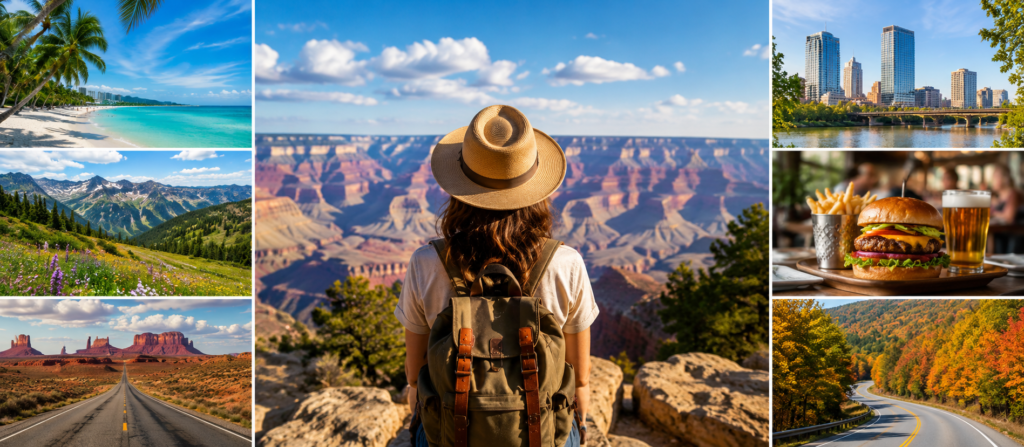
A traveler can choose beaches in Florida, national parks in the West, food-focused city breaks, mountain destinations, desert landscapes or a classic American road trip without leaving the country.
Road Trips Are Making a Comeback
The road trip has always been part of American travel culture, but economic pressure is giving it another reason to appeal.
The latest State of the American Traveler research reports that travelers are increasingly choosing road trips and booking closer to departure, while higher gasoline costs remain one of the biggest obstacles to taking additional trips.
That may sound contradictory, but the appeal of driving is not necessarily about being cheaper in every situation.
It is about control.
A road trip allows travelers to:
- Choose their departure time
- Avoid airport queues
- Stop in smaller towns
- Adjust the itinerary
- Travel with more flexibility
- Combine several experiences into one trip
For solo travelers, driving can also make it easier to explore areas that aren’t well served by public transportation.
The Smart Way to Plan a 2026 Road Trip
Higher fuel prices mean travelers should think beyond the basic question of how much gasoline will cost.
Before leaving, compare:
- Fuel costs
- Rental-car costs, if applicable
- Parking fees
- Hotel prices
- Distance between stops
- Toll charges
- Alternative transportation options
A shorter road trip with fewer hotel changes can sometimes deliver a better experience than trying to cover an enormous distance in a few days.
Travelers Are Booking Differently
Another major change is when Americans make travel decisions.
Recent August 2026 traveler research indicates that people are increasingly making plans closer to departure rather than locking everything in far in advance.
That behavior can be driven by uncertainty around prices, work schedules and household budgets.
It also creates opportunities for travelers who are flexible.
If your dates aren’t fixed, you can compare several destinations before choosing where to go. Instead of deciding on one city first and accepting whatever flights and hotels cost, travelers can reverse the process:
Check the price → compare destinations → choose the trip.
That small change can make a major difference to the overall travel budget.
AI Is Changing How Americans Plan Trips
Perhaps the most futuristic travel trend of 2026 is happening before travelers even leave home.
AI is becoming a travel-planning tool.
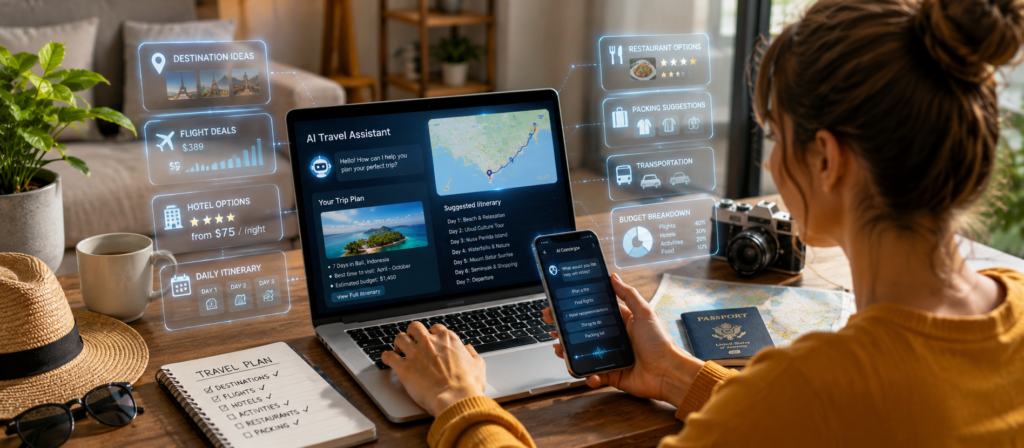
Google reports that search interest in “AI travel assistant” and “AI concierge” increased by 350% over the previous year. Searches around using AI to find flight deals also became a notable travel topic, while “AI flight booking” experienced a sharp spike.
For travelers, the attraction is obvious.
Instead of opening dozens of websites and manually comparing options, someone can use AI to help organize:
- Destination ideas
- Daily itineraries
- Restaurant options
- Neighborhood comparisons
- Packing suggestions
- Transportation plans
- Activity ideas
- Budget breakdowns
AI does not eliminate the need to verify information, but it can dramatically reduce the time required to create a first draft of a trip.
How to Use AI Without Losing the Human Part of Travel
The best use of AI is not to let it make every decision.
Use it for research and organization, then verify important details yourself.
For example, AI can suggest three neighborhoods. You can then check current hotel reviews and transportation options.
AI can create an itinerary. You can remove activities that feel too rushed.
AI can suggest restaurants. You can check their current hours and recent reviews before visiting.
The technology works best as an assistant rather than a replacement for judgment.
Slow Travel Is Replacing the Rush to See Everything
Another major trend is slow travel.
Google says search interest in slow travel reached an all-time high in 2026, while searches for “slow travel Italy” increased 100% in the past month covered by its report. Searches related to month-long hotel stays and month-long yoga retreats were also among the top trending “month long” searches.
The idea is straightforward.
Instead of visiting five cities in seven days, travelers stay longer in one location.
That can mean learning the local food scene, walking through neighborhoods, taking day trips or simply having unplanned time.
Slow travel is particularly attractive to people who find traditional sightseeing exhausting.
You don’t need to ask, “What can I fit into today?”
You can ask, “What would I actually enjoy doing today?”
Experiential Travel Is Becoming More Important
Travelers are also looking beyond famous landmarks.
Google’s 2026 travel data shows rising interest in activities and food experiences. In Kansas City, for example, people searching for things to do were also searching for barbecue and fried chicken, while searches for restaurants in Mexico City reached a 10-year high.
That tells us something important about modern travel.
The destination itself is only part of the experience.
Food, music, local neighborhoods, outdoor activities and cultural experiences can become the reason for choosing a destination.
For travel publishers and bloggers, this also creates an opportunity to move beyond generic “Top 10 Places” content.
Readers increasingly want to know:
What will I actually do when I get there?
Higher Travel Costs Are Changing the Way Americans Vacation
The travel boom is happening alongside financial pressure.
Deloitte’s 2026 Summer Travel Survey found that only 45% of surveyed Americans planned vacations involving paid lodging, the lowest share in its six-year survey history. Cost was a major reason some people were staying home.
At the same time, travelers who were planning trips were not necessarily giving up on experiences.
Deloitte found that intended trip budgets were higher among travelers, with some travelers choosing to spend more rather than significantly compromise their plans.
That creates a divided travel market.
Some Americans are cutting back.
Others are spending more for experiences they consider worthwhile.
This is why the phrase “value” may be more useful than simply “cheap” when discussing travel in 2026.
A good-value vacation doesn’t necessarily mean the lowest possible price. It means getting enough enjoyment, convenience and experience for what you spend.
Shorter Trips Could Become More Attractive
The U.S. Travel Association expects domestic leisure travel spending to grow modestly in 2026, while also noting that travelers are likely to shift toward shorter-duration and lower-cost trips, including regional and drive markets, as costs remain elevated.
That could make the long weekend one of the most useful travel formats of the year.
Instead of saving for one enormous vacation, travelers may choose several smaller trips.
For example:
Friday: Drive to a nearby destination.
Saturday: Explore the city or surrounding area.
Sunday: Take a slower morning and return home.
This approach reduces the amount of vacation time required while still providing a meaningful break from normal routines.
The 2026 Traveler Wants Flexibility
Put all of these trends together and a pattern becomes clear.
The modern American traveler increasingly wants flexibility.
They want to decide when to travel, where to stay, how long to remain there and what experiences matter most.
That explains why several seemingly unrelated trends are growing simultaneously:
- Solo travel provides personal freedom.
- Road trips provide transportation flexibility.
- Domestic travel simplifies logistics.
- Slow travel reduces itinerary pressure.
- AI makes planning easier.
- Group tours provide social connection.
- Shorter trips can reduce the financial commitment.
These aren’t isolated trends.
They’re different solutions to the same underlying desire: travel that fits the individual rather than forcing the individual to fit the trip.
What About International Travel?
Domestic travel is strong, but Americans haven’t stopped looking overseas.
In fact, U.S. international travel has remained remarkably resilient.
Recent reporting based on U.S. travel data found that more than 56 million U.S. residents traveled internationally in 2025, up from 53.7 million in 2024. A record 27.3 million U.S. passports were issued during fiscal year 2025.
So the story isn’t that Americans are choosing domestic travel instead of international travel.
It’s more nuanced.
Travelers are choosing different trips for different circumstances.
A three-day weekend may be perfect for a domestic destination.
A longer vacation may justify an international journey.
The same traveler can want both.
Shoulder-Season Travel Could Be the Next Big Opportunity
Another trend worth watching is the move away from peak summer travel.
Recent airline-industry reporting indicates that premium travelers are increasingly choosing September and October trips to avoid intense summer heat and crowds in destinations such as Europe and Japan.
That could make fall increasingly attractive.
For travelers with flexible schedules, shoulder season can offer a different experience from the traditional summer vacation.
Instead of asking, “Where should I go in July?”
The better question may be:
“Where should I go when the crowds and temperatures are more manageable?”
7 Ways to Travel Smarter in 2026
If you’re planning a trip this year, these strategies can help.
1. Compare destinations before booking flights
Don’t automatically choose the destination first.
Look at several destinations and compare total trip costs.
2. Consider driving
For shorter domestic trips, calculate the full cost of driving versus flying.
3. Leave room in your itinerary
Don’t schedule every hour.
Some of the best travel memories happen between planned activities.
4. Use AI for research
Let AI help generate ideas, organize options and build an initial itinerary, then verify important information.
5. Consider traveling alone
If friends or family aren’t available, don’t automatically assume that means you cannot travel.
6. Look beyond peak season
Check fall and other shoulder-season dates before committing to expensive summer travel.
7. Spend on experiences that matter
Rather than trying to minimize every expense, identify the one or two experiences you genuinely care about and build your budget around them.
Common Mistakes Travelers Should Avoid
Even the best travel trends can lead to bad decisions when followed blindly.
Booking a Trip Only Because It Is Trending
A destination becoming popular doesn’t automatically mean you’ll enjoy it.
Your interests should come first.
Building an Overpacked Itinerary
Trying to see everything can turn a vacation into a logistical exercise.
Trusting AI Without Verification
AI-generated recommendations can become outdated. Always verify important details such as prices, operating hours, entry requirements and transportation information.
Ignoring the Total Trip Cost
A cheap flight can become expensive after baggage, transportation, hotels and activities are added.
Choosing a Destination Without Considering Weather
Weather can dramatically change the quality of an outdoor vacation.
Assuming Solo Travel Requires Complete Independence
Solo travelers can still join tours, meet people and participate in group activities.
Is Solo Travel Worth Trying in 2026?
For many Americans, yes.
The strongest argument for solo travel isn’t simply that it is trending.
It is that it solves a common problem: waiting for other people to be ready.
If you’ve wanted to travel but haven’t been able to coordinate schedules with friends or family, a solo trip can remove that barrier.
Start small.
A one-night trip can be enough to learn whether you enjoy traveling alone. From there, a weekend getaway can become a longer domestic vacation.
You don’t need to begin with a month-long international adventure.
What These Trends Mean for Fall 2026 Travel
As summer winds down, the travel landscape may become even more interesting.
Travelers who avoided peak-season prices could begin looking toward fall. Those who prefer cooler weather may have more reason to delay European or other warm-weather trips. Meanwhile, domestic road trips and shorter vacations can remain practical options.
The biggest opportunity may belong to travelers who are flexible.
Flexible dates.
Flexible destinations.
Flexible itineraries.
And, increasingly, flexible ideas about what a vacation is supposed to look like.
Key Takeaways
- Solo travel is one of the clearest travel trends in the U.S. in 2026.
- Google reports record interest in solo travel and a 15-year high for women solo travel searches.
- Domestic travel remains a major part of American travel demand.
- Road trips are gaining attention as travelers respond to higher travel costs and seek more flexibility.
- AI is rapidly becoming part of the travel-planning process, with strong growth in searches for AI travel assistants.
- Slow travel is gaining popularity as travelers look for deeper experiences rather than packed itineraries.
- Rising prices are pushing some Americans toward shorter or more carefully planned vacations.
- International travel remains strong, showing that Americans are not abandoning overseas vacations.
- Fall and shoulder-season travel may become increasingly attractive as travelers look for alternatives to peak summer conditions.
Conclusion
The biggest U.S. travel story of 2026 isn’t a single destination.
It’s a change in how Americans think about travel.
People are traveling alone more often. They’re taking domestic trips, driving instead of flying when it makes sense, staying longer in fewer places and using AI to simplify the planning process. At the same time, higher prices are forcing travelers to become more deliberate about where their money goes.
The result is a traveler who is less interested in following a standard vacation formula.
For some, that means a solo weekend in a new city. For others, it means a road trip with no strict schedule. Someone else might spend an entire month exploring one destination instead of rushing through five.
There is no single right way to travel in 2026.
And perhaps that is the biggest trend of all: Americans increasingly want vacations built around their own interests, schedules and definition of a good experience.
FAQs
Is solo travel becoming more popular in the U.S. in 2026?
Yes. Google reports that search interest in “solo travel” reached an all-time high in 2026, while searches for “women solo travel” reached a 15-year high.
What is the biggest travel trend in the U.S. right now?
Solo travel is one of the most visible trends, but domestic travel, road trips, slow travel and AI-assisted travel planning are also significant parts of the 2026 travel landscape.
Are Americans traveling domestically in 2026?
Yes. Expedia reported that 63% of U.S. travelers planned a domestic trip for summer 2026, while the U.S. Travel Association expects domestic travel to account for the majority of U.S. travel spending.
Is AI useful for planning a vacation?
AI can be useful for generating destination ideas, comparing options and creating itinerary drafts. However, travelers should verify important information such as current prices, schedules, entry requirements and operating hours.
Is solo travel safe?
Solo travel can be rewarding, but travelers should research their destination, accommodation location, transportation options and local conditions before departure. Extra planning is particularly important for first-time solo travelers.
Why are road trips becoming popular again?
Road trips give travelers more control over schedules and destinations. Current travel research also shows Americans are increasingly considering road trips as they adjust their plans around higher travel costs.
What is slow travel?
Slow travel means spending more time in fewer destinations instead of trying to visit as many places as possible. Google reports that interest in slow travel reached an all-time high in 2026.
Are Americans still traveling internationally?
Yes. More than 56 million U.S. residents traveled internationally in 2025, according to recent reporting based on U.S. travel data.
Other Articles

Frank Beard Dies at 77: ZZ Top Drummer and Rock Icon Remembered

No Comment! Be the first one.