





The Nepal flood 2026 disaster has become one of the most serious Himalayan flooding events of the year after a sudden torrent of water, ice, rock and mud tore through communities along the Nepal-China border.
What initially appeared to some observers to be an earthquake-related disaster is now understood to have been driven primarily by a glacial collapse and massive ice-and-rock avalanche that entered a mountain river system and transformed into a destructive debris flow.
The disaster has attracted particular attention in the United States because American citizens are among the foreign nationals reported missing in the affected region, many of whom were traveling in an area known for trekking, tourism and religious pilgrimage. U.S. travelers are therefore a major part of the international concern surrounding the catastrophe.
The situation remains fluid. Rescue teams are still searching for people, roads and bridges have been destroyed, and authorities are dealing with additional flooding risks in the Himalayan border region.
So what exactly happened?
And how could a glacier collapse create a flood powerful enough to sweep away roads, bridges, buildings and entire sections of river valleys?
Here is what the latest evidence shows.
What Happened in Nepal in August 2026?
The disaster struck on Wednesday in the mountainous region around the Nepal-Tibet border, where narrow valleys channel rivers through some of the world’s steepest terrain.
A massive collapse involving glacial ice and rock sent material crashing downward into the Lhende Khola river, a tributary connected to the Bhotekoshi river system.
Instead of producing an ordinary river flood, the event created a rapidly moving mixture of water, ice, rock, mud and sediment.
That mixture behaved more like a gigantic landslide moving through a river valley.
The resulting flood and debris flow traveled downstream with enormous force, damaging settlements and critical infrastructure in both Nepal and Tibet.
Reuters reported that the debris flow traveled at speeds of roughly 50 meters per second and extended for more than 20 kilometers. The event also changed river channels over a much larger downstream area.
This helps explain why people in the affected communities had so little time to react.
A conventional flood can sometimes rise gradually enough for residents to receive warnings and evacuate.
A high-altitude ice-and-rock collapse is different.
Once the material begins moving, gravity can accelerate it rapidly down steep mountain slopes. When it reaches a river, enormous quantities of sediment and water can become incorporated into the flow.
The result can be a fast-moving wall of destructive material.
How Did the Nepal Flood 2026 Start?
The most important development in understanding the disaster came from geological analysis.
Early reports suggested that an earthquake might have triggered the event. A seismic signal was initially interpreted as a possible earthquake, creating confusion during the first hours of the disaster.
Further analysis by the U.S. Geological Survey changed that picture.
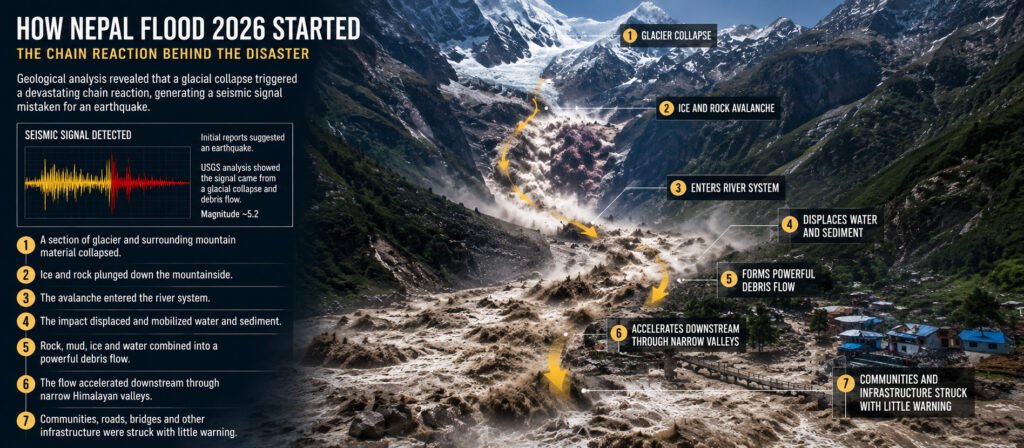
According to scientific reporting, the seismic signal was associated with a glacial collapse and debris flow, rather than a conventional earthquake. The collapse itself generated a seismic signal equivalent to approximately magnitude 5.2, which helps explain why the initial event was mistaken for an earthquake.
That distinction matters.
The earthquake was not simply an earthquake that caused a flood.
Instead, a large collapse of ice and rock appears to have initiated a chain reaction:
- A section of glacier and surrounding mountain material collapsed.
- Ice and rock plunged down the mountainside.
- The avalanche entered the river system.
- The impact displaced and mobilized water and sediment.
- Rock, mud, ice and water combined into a powerful debris flow.
- The flow accelerated downstream through narrow Himalayan valleys.
- Communities, roads, bridges and other infrastructure were struck with little warning.
This cascading process is one of the key reasons the Nepal flash flood 2026 became so destructive.
The Glacier Collapse Was the Critical Trigger
Scientists examining satellite imagery believe a substantial section of ice collapsed from a high elevation near the Langtang Lirung area.
One analysis cited by scientific reporting suggested that a chunk of ice covering roughly 0.2 square kilometers may have collapsed from around 5,200 meters above sea level and fallen approximately 1,200 meters toward the valley floor.
That is an enormous vertical drop.
When a huge mass of ice and rock falls thousands of feet, gravitational energy is converted into motion.
The material does not simply land and stop.
It can fracture, melt, pulverize surrounding rock and snow, and interact with water as it moves downhill.
Once the debris reaches a river, the consequences can become even more severe.
A river that normally carries water suddenly has to carry enormous quantities of sediment and debris as well.
That can dramatically increase the volume and destructive power of the flow.
Scientists have described this kind of process as a cascading sequence in which a glacier or mountain collapse produces water and sediment, which then combine into a much larger and more mobile flood.
Why Was the Flood So Destructive?
Nepal’s geography played a major role.
The Himalayan landscape is characterized by extremely steep slopes, narrow valleys and rapidly flowing rivers.
That means water and debris released high in the mountains can gain tremendous momentum as they move toward lower elevations.
The Lhende Khola and Bhotekoshi river system became a natural pathway for the disaster.
Instead of spreading slowly across a broad plain, the flood was funneled through confined mountain valleys.
That concentration of energy can make flash floods dramatically more destructive.
Researchers reported that water levels in the affected river system rose by as much as 9 meters in approximately half an hour.
For people living or traveling nearby, that represents an extremely short window for escape.
The flood also carried much more than water.
It contained:
- Large rocks
- Glacial ice
- Mud
- Sand
- Broken vegetation
- Mountain debris
- Sediment
- Infrastructure fragments
This is why describing the event simply as a “flood” does not fully capture what happened.
It was a complex flash-flood and debris-flow disaster generated by a mountain collapse.
Why Were So Many Tourists and Americans in the Area?
The affected Himalayan region is not isolated from international travel.
Nepal is one of the world’s major destinations for trekking, mountaineering, cultural tourism and pilgrimage.
International visitors travel through mountain corridors that connect communities and tourist destinations.
That is one reason the disaster quickly became an international story.
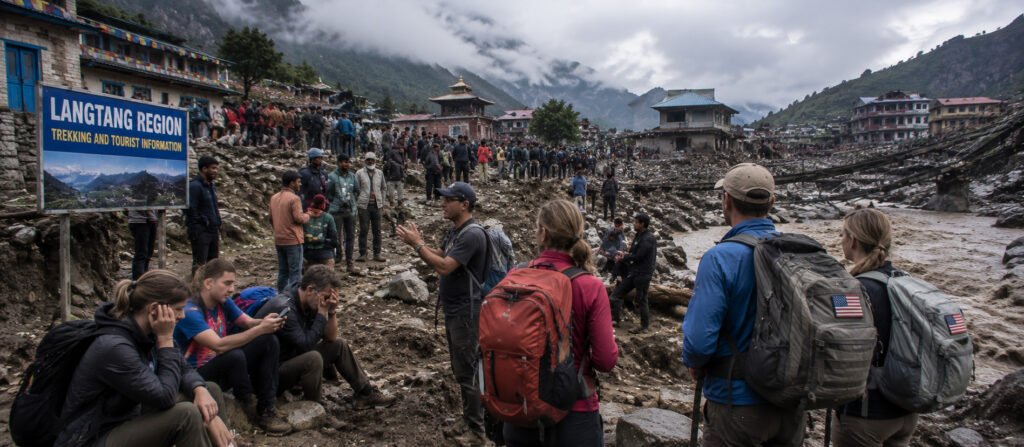
Among those reported missing were foreign nationals from numerous countries, including the United States.
Initial reports from Nepal indicated that Americans were among the missing foreign visitors. ABC News reported that at least 47 Americans were included in a preliminary list of people reported missing, although figures can change as authorities identify survivors and reconcile missing-person reports.
For American families, this has turned a distant Himalayan disaster into a deeply personal crisis.
Families may not know whether a missing traveler is safe, injured, stranded or simply unable to communicate.
The destruction of roads, bridges and communications infrastructure makes that uncertainty even worse.
Why Are Americans Particularly Concerned About the Nepal Flood?
For U.S. readers, one of the biggest questions is not only how many people died, but how many Americans may still be unaccounted for.
Nepal is a popular destination for adventurous American travelers, including trekkers and people visiting the Himalayas.
When a disaster destroys roads and communication systems in a remote mountainous area, even people who survived may have difficulty contacting relatives.
A missing-person report therefore does not automatically mean that the individual has died.
Some travelers can be stranded in remote locations without electricity, phone service or transportation.
That is why authorities continue to update the numbers as rescue operations progress.
The American connection has also increased attention from U.S. news organizations and families attempting to determine whether relatives, friends or travel companions were in the affected areas.
For Americans planning future travel to Nepal, the event also raises broader questions about mountain-weather risks, emergency communication and the limitations of conventional flood warnings in high-altitude environments.
What Is the Current Nepal Flood Death Toll?
The death toll has changed rapidly as rescue workers gain access to previously isolated areas.
Reports on August 28 indicated that the combined disaster across the Nepal-Tibet border had resulted in hundreds of deaths and a very large number of people reported missing. Associated Press reporting later placed Nepal’s reported death toll at 579, while China reported additional deaths and hundreds of missing people in Tibet.
Because rescue and identification operations are still underway, readers should be cautious with any single number presented as final.
The same is true for missing-person figures.
Early lists can include people who are later found alive, while remote communities may remain inaccessible for days.
For that reason, the humanitarian scale of the Nepal flood should be understood as ongoing rather than finalized.
The Rescue Operation Faces Major Challenges
Rescuers are working in some of the most difficult terrain on Earth.
The disaster damaged or destroyed:
- Roads
- Bridges
- Homes
- Power facilities
- Communications infrastructure
- River crossings
- Access routes into affected communities
That makes conventional ground rescue extremely difficult.
Helicopters can reach some isolated locations, but aviation operations are also dependent on weather and safe landing conditions.
Thousands of security personnel have been involved in rescue and recovery efforts, while international organizations and governments have begun mobilizing assistance.
The challenge is not simply finding survivors.
Rescue teams must also deliver food, drinking water, medical supplies and other necessities to communities that may have been cut off from the rest of the country.
Could There Be More Flooding?
One of the most concerning developments after the initial disaster is the possibility of additional flooding.
The original avalanche and debris flow altered the landscape and river system.
In mountainous environments, landslides and glacier collapses can temporarily block rivers and create unstable lakes behind natural dams.
If such a barrier fails, the stored water can suddenly move downstream.
Reports have warned of newly formed water bodies and additional flood risks in the region, prompting authorities to monitor the situation closely.
This creates a dangerous secondary phase of the disaster.
Even after the first flood passes, the landscape may remain unstable.
That means residents and rescue workers can face continuing risks from:
- Additional landslides
- Rockfalls
- Glacier instability
- River blockages
- Sudden lake breaches
- Aftershocks or further mountain movement
- Damaged bridges collapsing
- Secondary flash floods
For this reason, rescue operations must balance speed with safety.
Was Climate Change Responsible for the Nepal Flood?
This is one of the most complicated questions surrounding the disaster.
Scientists have strong evidence that climate change is accelerating glacier retreat and destabilizing high-mountain environments.
But it would be too simplistic to say that climate change alone “caused” this particular flood.
The immediate trigger appears to have been a glacial collapse and resulting avalanche.
The bigger scientific question is whether warming conditions helped make the mountain system more unstable.
Researchers have pointed to several possible climate-related mechanisms.
Warmer Temperatures Can Destabilize Glaciers
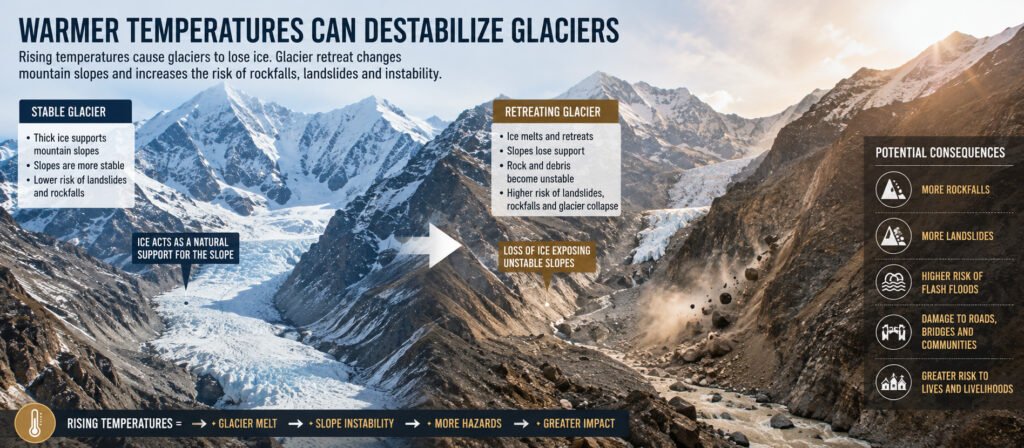
As temperatures rise, glaciers lose ice.
Glacier retreat changes the physical structure of mountain slopes and can expose areas that were previously stabilized by ice.
That can increase the possibility of rockfalls, landslides and other forms of instability.
Melting Permafrost Can Weaken Mountains
High-altitude mountain slopes can contain permanently frozen ground known as permafrost.
Permafrost can act like a natural binding material within rocky terrain.
When warming causes frozen ground to thaw, the strength of the slope can change.
Scientists therefore monitor mountain permafrost as an important factor in understanding future landslide and glacier hazards.
Climate Change Is Not a Simple One-to-One Explanation
Experts have emphasized that it is too early to make a definitive claim that climate change directly caused the specific glacier collapse responsible for the August 2026 disaster.
Large glacier collapses are relatively rare and difficult to study.
What scientists can say with much greater confidence is that the Himalayas are warming and glaciers are retreating, creating environmental conditions that can increase certain mountain hazards.
The region is therefore becoming an increasingly important area for climate and disaster research.
Why the Himalayas Are Becoming a Global Climate Warning
The Nepal flood is not only a story about one valley.
The Himalayas contain enormous stores of frozen water that feed rivers across Asia.
Those rivers support communities, agriculture, energy production and ecosystems far beyond Nepal.
Changes in glaciers therefore have consequences that can extend hundreds or thousands of miles downstream.
The United Nations has reported significant glacier loss in Nepal and across the Hindu Kush Himalaya region, while scientists have warned that warming can increase the risks associated with glacier retreat, unstable slopes and glacial lakes.
That makes disasters such as the Nepal flood 2026 important to audiences in the United States even though the event occurred thousands of miles away.
The story connects extreme weather, climate change, international travel, disaster preparedness and global water security.
Nepal’s Geography Makes Flash Floods Especially Dangerous
Nepal’s mountain geography creates a unique combination of hazards.
A single event can trigger several others.
For example:
Glacier instability → avalanche → landslide → river blockage → debris flow → flash flood
That chain can happen rapidly.
In a flat region, water may have room to spread.
In a Himalayan valley, the terrain can concentrate the flow into a narrow corridor.
This increases the destructive force.
It also makes evacuation particularly difficult.
A village located downstream may have little warning if the initial collapse occurs several miles away and the river rapidly carries the resulting debris toward it.
Why the Initial Earthquake Reports Were Confusing
One of the most interesting aspects of the disaster is how the initial seismic signal created confusion.
When a huge mass of ice and rock collapses, the movement can produce measurable vibrations in the ground.
Those vibrations can resemble an earthquake on monitoring equipment.
That appears to have happened during this event.
Early reports therefore connected the disaster with an earthquake.
Later analysis by the U.S. Geological Survey indicated that the seismic signal was associated with the glacial collapse and debris flow rather than a tectonic earthquake.
This is an important distinction because it changes how scientists understand the chain of events.
The disaster was not simply a conventional earthquake followed by flooding.
It was a mountain-collapse event that generated a powerful flood and debris flow.
What This Means for Americans Traveling to Nepal
The disaster does not mean Americans should automatically avoid Nepal.
But it does highlight the importance of understanding mountain hazards before traveling.
Travelers heading into remote Himalayan areas should take several precautions.
Before Traveling
Check:
- Local weather forecasts
- Government travel advisories
- Mountain road conditions
- River and flood warnings
- Trekking-route conditions
- Local emergency contacts
- Communications availability
Travelers should also make sure family members know their itinerary.
During a Mountain Trip
Keep important documents and emergency contact information accessible.
Where possible, travelers should maintain communication through reliable mobile or satellite systems.
They should also follow instructions from local authorities and trekking operators if officials order an evacuation.
Most importantly, travelers should never assume that clear weather in their immediate location means conditions are safe upstream.
A flash flood can originate many miles away.
The Broader Lesson From the Nepal Flood 2026
The most important lesson from this disaster may be that modern flood risks are becoming increasingly complicated.
A flood does not always begin with heavy rain.
In mountainous environments, a flood can begin with ice.
Or rock.
Or a landslide.
Or a glacier collapse.
Those events can then combine.
That makes early-warning systems particularly important.
Scientists and disaster-management agencies need systems capable of detecting not only rainfall but also sudden changes in glaciers, mountain slopes, rivers and high-altitude lakes.
For communities living downstream, minutes can make the difference between life and death.
What We Know — and What Remains Unclear
At this stage, several facts are becoming increasingly clear.
What We Know
- A catastrophic flash flood struck the Nepal-China border region in August 2026.
- A major glacial collapse and ice-rock avalanche played a central role.
- The resulting debris flow entered the Lhende Khola/Bhotekoshi river system.
- Water, ice, rock and sediment moved rapidly downstream.
- Roads, bridges, homes and infrastructure were destroyed.
- Foreign nationals, including Americans, were among those reported missing.
- Rescue and recovery operations remain underway.
- Additional flooding risks remain a concern.
- Scientists are investigating the relationship between the disaster and a warming Himalayan environment.
What Remains Unclear
Several questions will require further investigation:
- The final death toll
- The final number of missing people
- The precise volume of ice and rock involved
- The exact sequence of glacier, slope and river failures
- How much warming contributed to the glacier’s instability
- The long-term damage to communities and infrastructure
- Whether additional unstable lakes or river blockages could create new floods
Those answers will become clearer as satellite imagery, geological surveys and on-the-ground investigations continue.
Why the Nepal Flood Is Drawing U.S. Attention
For American readers, this disaster combines several major concerns.
It involves missing U.S. citizens.
It affects a popular international travel destination.
It raises questions about climate change and extreme mountain hazards.
And it demonstrates how quickly a natural disaster can become an international emergency.
The number of Americans reported missing has also made the story especially important to U.S. families and news organizations.
As rescue teams continue searching isolated communities, the focus is now shifting from understanding what happened to determining how many people survived, where they are located and how they can be safely reached.
Key Takeaways
The Nepal flood 2026 was not simply a conventional rainstorm flood.
The disaster appears to have followed a dramatic chain reaction in the Himalayas:
Glacial collapse → ice and rock avalanche → river impact → debris flow → catastrophic flash flooding
The U.S. connection is significant because American travelers are among the foreign nationals reported missing.
The disaster also highlights a larger scientific concern: as the Himalayas warm and glaciers retreat, mountain environments may become increasingly vulnerable to complex hazards involving ice, rock, water and unstable slopes.
For now, the priority remains rescue.
The final human cost of the disaster is still being determined, and authorities continue working to reach isolated communities and account for missing people.
What Happens Next in the Nepal Flood Recovery?
The immediate priority is finding survivors and reaching communities that remain cut off by damaged roads and bridges. Once emergency access improves, authorities will face a much longer recovery effort involving housing, transportation, communications, electricity and water supplies.
For families of missing foreign nationals, identification and communication will remain especially important. Search teams must work through areas where debris may have completely changed the landscape, while authorities continue comparing missing-person reports with lists of people who have reached safety.
The recovery will therefore continue well beyond the first days of the disaster.
What Can Be Learned From the 2026 Nepal Disaster?
One of the clearest lessons is that disaster preparedness in mountainous regions cannot depend on rainfall warnings alone.
A river can become dangerous because of an event occurring far upstream. A glacier collapse, landslide or sudden release of water can transform a relatively normal river into a destructive flow within minutes.
That means communities need multiple layers of protection, including:
- Better glacier and slope monitoring
- Faster river-level alerts
- Satellite-based hazard detection
- Evacuation routes above flood-prone valleys
- Reliable communication systems
- Regular emergency drills
- Better coordination between local and national authorities
- International support for remote mountain communities
For tourists, the same principle applies. Understanding the geography and hazards of a destination can be just as important as checking the weather forecast.
Nepal Flood 2026: A Disaster With Global Implications
The tragedy unfolding in Nepal and Tibet is a reminder that extreme mountain disasters do not remain purely local events.
Nepal is connected to a global tourism industry, while the Himalayan region is central to the world’s freshwater systems and climate research.
When glaciers change, the effects can eventually be felt downstream across borders.
For the United States, the disaster also demonstrates how international travel can quickly connect American families to emergencies occurring thousands of miles away.
The reported missing Americans are one part of a much larger humanitarian crisis, but their cases have brought additional attention in the U.S. to the dangers facing travelers in remote Himalayan environments.
As investigators continue reconstructing the event, scientists will also be watching closely for evidence that could help improve early-warning systems elsewhere in the Himalayas.
Final Perspective
The Nepal flood 2026 disaster began with a sudden and extraordinarily powerful geological and glacial event.
A collapse of ice and rock sent material into the mountain river system, where water, sediment and debris combined into a fast-moving flow capable of destroying infrastructure and sweeping through downstream communities.
The tragedy is still developing, and the final number of deaths and missing people may not be known for some time.
For Americans following the story, the most important development will be the continuing search for missing U.S. citizens and other foreign nationals.
For scientists, the disaster provides another warning about the complexity of hazards in a rapidly changing Himalayan environment.
And for Nepal, the immediate challenge is far more basic: rescuing survivors, restoring access and helping devastated communities begin rebuilding.
The Nepal flood is therefore both an unfolding humanitarian emergency and a powerful reminder of how quickly the Himalayan landscape can turn dangerous.
FAQs
What caused the Nepal flood in 2026?
The 2026 Nepal flood was triggered by a major collapse involving glacial ice and rock in the Himalayan region. The material entered the river system and generated a powerful debris flow containing water, ice, mud and rock.
Was the Nepal flood caused by an earthquake?
Early reports raised the possibility of an earthquake because the initial collapse generated a significant seismic signal. Later analysis indicated that the signal was associated with the glacial collapse and debris flow rather than a conventional tectonic earthquake.
Are Americans missing in the Nepal flood?
Yes. Nepalese authorities reported that American citizens were among foreign nationals reported missing after the disaster. The number can change as rescue teams locate people and authorities update their lists.
How many people died in the Nepal flood?
The reported death toll has continued to change as rescue teams reach affected areas. Because the disaster is ongoing, early figures should not be treated as the final death toll.
Did climate change cause the Nepal flood?
Climate change should not be described as the sole direct cause of this particular event. However, scientists have linked warming temperatures with glacier retreat, changing mountain permafrost and increasing instability in some high-altitude environments.
Why was the Nepal flash flood so powerful?
The disaster occurred in steep Himalayan terrain. When the glacier and rock collapse entered the river system, enormous amounts of water and sediment were forced through narrow valleys, producing a fast and highly destructive debris flow.
Is Nepal safe for American tourists?
Nepal remains a major international tourism destination, but travelers heading into remote Himalayan areas need to pay close attention to weather, flood warnings, landslide risks, route conditions and local authorities’ instructions.
Could another flood happen?
Additional hazards remain possible after a major glacier or landslide event. Natural river blockages, unstable slopes and newly formed water bodies can create secondary flooding risks, which is why authorities continue monitoring the affected region.
Why is the Nepal flood important to the United States?
The disaster has direct relevance to the U.S. because American citizens were among those reported missing. It is also important for American travelers, climate researchers and anyone interested in extreme-weather and mountain hazards.
Other Articles

10 Best Personal AI Tools in 2026 for Everyday Life
Wing Kings El Paso Review 2026: Menu, Prices & Locations





No Comment! Be the first one.