





The WNBA’s rapid rise produced another emotional scene this week, and this time it was ESPN veteran Holly Rowe Caitlin Clark who found herself struggling to hold back tears.
Before the Indiana Fever faced the expansion Toronto Tempo at Scotiabank Arena on Aug. 18, Rowe recorded an emotional video while taking in the atmosphere inside the sold-out building. Her reaction was not to a dramatic play or a heartbreaking loss. It was to the sight of a packed arena embracing women’s basketball.
But there was an obvious name hanging over the moment: Caitlin Clark.
Clark and the Fever were making their first WNBA trip to Toronto, and the former No. 1 overall pick remains one of the biggest draws in women’s sports. The Fever’s visit attracted a crowd of 19,300, with plenty of fans wearing Clark jerseys. Indiana ultimately defeated Toronto 101-95, with Clark contributing 24 points and seven assists.
That combination turned Rowe’s emotional reaction into a bigger conversation.
Was Caitlin Clark really the reason Holly Rowe was crying?
The answer is more complicated than the headline suggests.
Why Holly Rowe became emotional before the WNBA game
Rowe’s reaction came as she looked around Scotiabank Arena before the game.
The veteran ESPN reporter has covered women’s basketball for decades, including the WNBA since its early years. Seeing a new WNBA franchise playing in front of a full basketball arena in Toronto represented something much bigger to her than one regular-season game.
Rowe expressed her amazement at what Toronto had built and explained that she kept getting emotional while looking at the crowd. Her message focused on the growth of women’s basketball and the support surrounding the new Toronto franchise.
For someone who has spent years around the sport, the scene offered a striking contrast with earlier eras of women’s basketball.
The WNBA is now attracting major crowds, international attention and increasingly intense fan interest. Toronto’s game against Indiana was another example of that evolution.
And then there was Clark.
Caitlin Clark is a major reason the moment became so interesting
While Rowe did not specifically credit Clark in her emotional video, it is difficult to discuss the atmosphere around this particular game without mentioning the Indiana star.
Clark has become one of the WNBA’s biggest attractions since entering the league. Her presence has repeatedly generated enormous attention, and Toronto was no exception.
The Fever’s arrival created a spectacle around Scotiabank Arena, with fans gathering well before tipoff and many wearing Clark’s No. 22 jersey. The announced crowd reached 19,300, filling the basketball configuration of the arena.
That does not mean every person in the building was there exclusively for Clark.
Toronto has its own growing basketball audience, and the Tempo are an important part of the WNBA’s expansion into Canada. But Clark’s influence on the game’s attention was impossible to ignore.
Even Clark herself acknowledged the atmosphere afterward.
Speaking with Rowe following the game, Clark praised the Toronto crowd and said it was exciting to see how much women’s basketball had grown.
That detail makes the story particularly interesting: Rowe and Clark were essentially reacting to the same phenomenon from two different perspectives.
Rowe was watching the league’s growth from the sideline.
Clark was experiencing it as one of the players driving that attention.
Why some fans criticized Holly Rowe
The emotional moment might have remained a feel-good WNBA story if social media had not taken another angle.
Some fans criticized Rowe because her video celebrated the Toronto crowd and the growth of women’s basketball without explicitly mentioning Caitlin Clark.
That omission became the center of a social-media debate.
Critics argued that Clark’s popularity was a significant factor in the enormous interest surrounding the game. Several online reactions suggested that Rowe should have acknowledged Clark when discussing the sellout crowd.
That criticism, however, is an interpretation from fans rather than evidence that Rowe was deliberately trying to dismiss Clark.
There is an important distinction.
Rowe did not say that Clark had nothing to do with the crowd.
She was speaking emotionally about the broader growth of women’s basketball.
Both things can be true at the same time.
Caitlin Clark can be a huge attraction while Toronto’s fans, the Tempo organization and the wider WNBA also deserve recognition for building interest in the sport.
The numbers show why Caitlin Clark was impossible to overlook
The game itself provided plenty of evidence of Clark’s importance to the occasion.
Indiana entered Toronto riding a winning streak, while the Fever had become one of the league’s most followed teams.
Clark finished with:
| Statistic | Caitlin Clark |
|---|---|
| Points | 24 |
| Assists | 7 |
| Team | Indiana Fever |
| Opponent | Toronto Tempo |
| Result | Indiana won 101-95 |
Kelsey Mitchell was actually Indiana’s leading scorer, finishing with 29 points. Clark nevertheless played a major role in the Fever’s fifth consecutive victory.
The result also produced another notable milestone for Indiana.
Clark and Mitchell have now combined for 20-plus-point performances in the same game 16 times this season, a WNBA record according to Associated Press reporting.
So while the conversation surrounding Rowe is largely emotional, the basketball story underneath it is significant too.
The Fever are winning.
Clark is producing.
And fans are showing up.
Toronto’s WNBA debut against Indiana was bigger than one player
The easiest way to interpret the night would be to make everything about Caitlin Clark.
But that would actually miss part of what made Rowe emotional.
Toronto is one of the WNBA’s newest markets, and the Tempo are part of the league’s expansion era. The 2026 season has brought new franchises and a broader footprint for women’s professional basketball.
For longtime WNBA observers, seeing Toronto fill a major arena represented progress regardless of which team was responsible for drawing the biggest individual share of attention.
That distinction matters.
The WNBA needs stars such as Clark.
It also needs strong local markets.
It needs new franchises.
It needs fans who support teams even when the biggest star in the building is wearing the opposing jersey.
Toronto’s crowd provided evidence that the league can create an event around women’s basketball on an international stage.
And Clark’s presence showed how a superstar can accelerate that process.
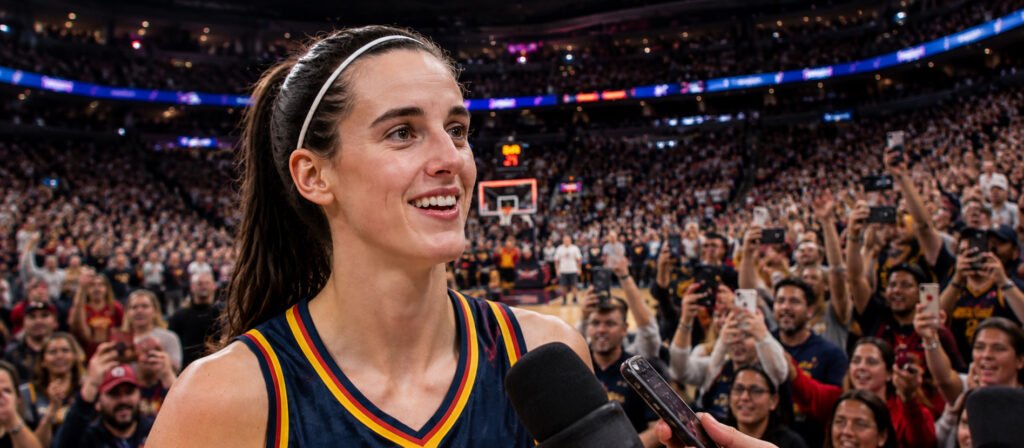
Caitlin Clark also praised Toronto’s fans
There was another important part of the story that received less attention than the Rowe controversy.
Clark herself praised the Toronto crowd after the game.
Her comments reflected the same broader theme that had moved Rowe before tipoff: women’s basketball is attracting audiences that would have seemed extraordinary in earlier stages of the league’s history.
Clark’s first WNBA game in Canada therefore became more than a normal road game.
It was a showcase for the league.
The Fever arrived with one of the sport’s biggest stars.
The Tempo had the opportunity to introduce themselves to a huge home audience.
And thousands of fans packed the building to watch it happen.
The game also had plenty of drama on the court
The emotional pregame scene was only one part of the night.
Indiana eventually escaped with a 101-95 victory, but Toronto made the Fever work for it.
Mitchell led all scorers with 29 points, while Clark added 24. Marina Mabrey scored 22 for Toronto, and Brittney Sykes returned to the Tempo lineup after missing more than two months.
There was also a heated exchange between Mitchell and Mabrey during the third quarter, resulting in technical fouls.
The contest showed why the WNBA’s growth is not simply about celebrity or attendance.
There is increasingly compelling basketball behind the attention.
That combination — recognizable stars, competitive games, strong local support and national media coverage — is exactly what a professional sports league needs to keep expanding.
Holly Rowe has witnessed the WNBA’s evolution firsthand
Rowe’s reaction carries additional weight because of her career.
She has covered women’s basketball for years and became a full-time ESPN reporter in 1998. Her career has included some of the most important moments in women’s basketball, giving her a perspective that newer viewers simply do not have.
That history helps explain why a packed arena could hit her emotionally.
A reporter who has spent decades watching women’s basketball develop is seeing a league with expansion franchises, enormous fan interest and increasingly international appeal.
The emotion was not necessarily about one person.
It was about seeing the sport become something much larger.
So, is Caitlin Clark really “to blame”?
If the phrase is being used playfully, there is a reasonable argument.
Clark is undeniably part of the enormous attention surrounding Indiana Fever games. Toronto’s sellout featured many Clark jerseys, and the Fever’s first trip to Canada generated major interest.
But saying Clark was literally responsible for Holly Rowe’s tears would go too far.
Rowe’s own explanation centered on the growth of women’s basketball and the Toronto crowd.
The more accurate interpretation is that Caitlin Clark was one important piece of a much bigger WNBA story.
Clark’s popularity helped bring new eyes to the league.
Toronto provided a new market.
The fans created the atmosphere.
The players delivered the game.
And Rowe, standing courtside after decades of covering the sport, saw the result.
That is why the moment resonated.
Why this story matters beyond Caitlin Clark
The debate around Rowe’s video also reveals something about the current WNBA media environment.
Clark has become such a dominant topic that even a story about the broader growth of women’s basketball can quickly become a debate about whether she received enough credit.
That is a reflection of her extraordinary popularity.
But it also creates a challenge for sports coverage.
The WNBA’s growth is bigger than any single player.
Clark matters enormously. So do A’ja Wilson, Breanna Stewart, Napheesa Collier, Kelsey Mitchell, Angel Reese and many other stars who have helped turn women’s basketball into appointment viewing.
Toronto’s emergence matters too.
So does the league’s expanding national and international audience.
The most compelling story may therefore be the combination of all of these forces.
What Holly Rowe’s emotional moment says about the WNBA in 2026
There was a time when conversations about women’s professional basketball were dominated by questions about whether the sport could attract enough attention.
Now the conversation is different.
Fans are arguing over which star deserves credit for a sold-out arena.
That is a very different problem.
The Toronto game demonstrated how quickly the WNBA has evolved. A new franchise hosted Indiana, one of the league’s most recognizable teams, and thousands of fans packed Scotiabank Arena.
Clark played well.
Mitchell produced a huge performance.
Toronto competed.
And Rowe became emotional watching the spectacle unfold.
That is not a bad problem for women’s basketball to have.
Key Takeaways
- Holly Rowe became emotional before the Indiana Fever’s game against the Toronto Tempo in Toronto.
- Rowe’s reaction centered on the growth of women’s basketball and the packed arena.
- The game drew an announced crowd of 19,300 at Scotiabank Arena.
- Caitlin Clark scored 24 points and added seven assists in Indiana’s 101-95 victory.
- Kelsey Mitchell led the Fever with 29 points.
- Many fans in attendance wore Caitlin Clark jerseys.
- Some fans criticized Rowe for not explicitly mentioning Clark in her emotional video.
- Clark herself praised the Toronto crowd after the game.
- The larger story is the WNBA’s continued growth, with Clark serving as one of its biggest stars.
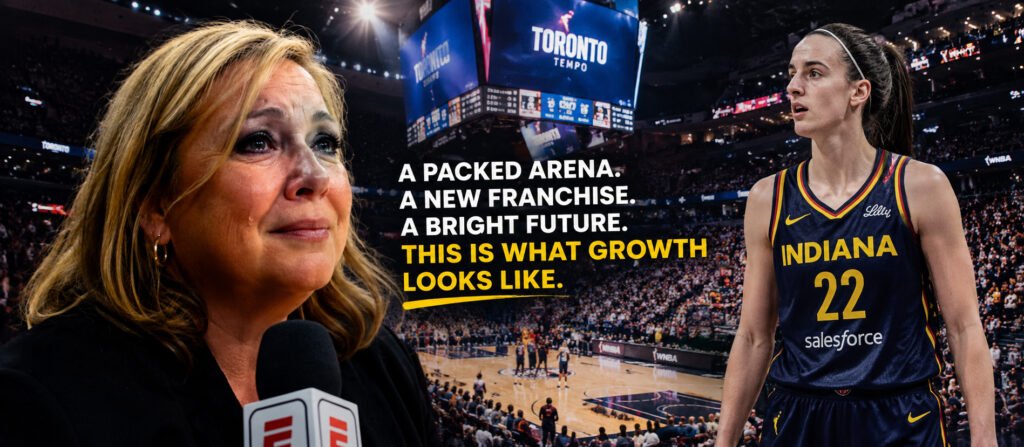
The Bottom Line
Holly Rowe’s tears were not simply about Caitlin Clark.
They were about what Caitlin Clark represents.
For years, the WNBA has worked to build audiences, develop stars and expand its footprint. In Toronto, Rowe saw a packed arena, a new franchise, a passionate crowd and one of the league’s biggest stars sharing the same stage.
Clark’s influence is clearly part of that picture.
But the emotional reaction belongs to something bigger: women’s basketball has reached a point where moments like this are becoming normal — and for people who have covered the sport for decades, that can still be overwhelming.
FAQs
Why was Holly Rowe crying before the WNBA game?
Holly Rowe became emotional while watching the packed crowd at Scotiabank Arena before the Indiana Fever played the Toronto Tempo. She expressed pride in the growth of women’s basketball and what Toronto had built around the new WNBA franchise.
Did Caitlin Clark make Holly Rowe cry?
Not directly, based on Rowe’s explanation. Her emotional reaction was focused on the growth of women’s basketball and the Toronto crowd. However, Clark was a major attraction at the game, making her an important part of the broader context.
How many people attended the Fever vs. Tempo game?
The game was announced as a sellout with approximately 19,300 fans at Scotiabank Arena.
How did Caitlin Clark perform against Toronto?
Clark finished with 24 points and seven assists as the Indiana Fever defeated the Toronto Tempo 101-95.
Did fans criticize Holly Rowe?
Yes. Some fans on social media criticized Rowe because her emotional video did not explicitly mention Caitlin Clark, arguing that Clark’s popularity helped drive interest in the game.
Who led Indiana in scoring?
Kelsey Mitchell led the Fever with 29 points, while Clark finished with 24.
Why was the Toronto game significant?
It represented another major moment for the expanding WNBA, with the new Toronto Tempo hosting a sellout crowd against one of the league’s most popular teams.


No Comment! Be the first one.