
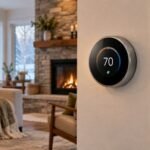

Heat pump thermostat settings for winter can affect comfort, electricity use, and how often your heating system calls on backup heat. A schedule designed for a gas furnace is not always the best schedule for a heat pump. Some systems warm a house gradually, and a large jump in the target temperature may activate electric resistance heat that costs more to operate.
There is no universal setting that guarantees the lowest bill. The right approach depends on climate, insulation, heat-pump type, backup heating, electricity prices, and household needs. This guide explains how to set a sensible baseline, test setbacks, understand the AUX indicator, and recognize when a problem needs maintenance rather than another thermostat adjustment.
Quick answer: heat pump thermostat settings for winter
- Mode: Use HEAT during heating season, not EMERGENCY HEAT for everyday operation.
- Temperature: Try approximately 68°F while occupied if it suits your household, then adjust for comfort.
- Schedule: Begin with a fairly steady temperature. Test small overnight or away setbacks before trying larger changes.
- Fan: AUTO is a reasonable starting choice for many ducted systems; follow manufacturer guidance for other designs.
- Recovery: Check whether your thermostat supports adaptive or heat-pump-aware recovery.
- Backup: Watch for unnecessary AUX use, but never disable needed backup heat without professional advice.
- Maintenance: Keep filters clean and airflow paths unobstructed.
Why heat pumps work differently from furnaces
Heat pumps transfer heat instead of generating it directly. In winter, an air-source heat pump draws thermal energy from outdoor air and moves it inside using refrigerant and a compressor. The U.S. Department of Energy explains that modern air-source systems can use substantially less electricity than electric resistance heating.
A gas furnace typically produces hot supply air in bursts. A variable-speed heat pump may run much longer at lower output, delivering moderately warm air while holding a stable indoor temperature. Long runtime alone does not mean the system is wasting electricity. What matters is whether it maintains comfort efficiently and without excessive backup heat.
Many ducted heat pumps include electric resistance strips. Those strips can help during extreme weather or when the thermostat requests a quick recovery. Unlike the heat pump, they do not move extra heat from outdoors; they convert electricity directly into heat. A dual-fuel system may instead use a gas furnace, which changes the operating-cost calculation. These differences explain why copied thermostat schedules can disappoint.
What temperature should a heat pump be set to in winter?
About 68°F is a useful starting experiment for many homes, not a mandatory rule or an official promise of maximum efficiency. Someone sitting at a desk may want a warmer room than someone moving around. Older adults, infants, and anyone with particular temperature needs may require a different setting. A well-insulated home with little draft may feel comfortable at a lower number than a leaky house.
Choose a comfortable baseline and keep it for several days. Record outdoor conditions, indoor temperature, and electricity use if your utility provides daily or hourly readings. Then adjust one thing at a time. Changing temperature, fan mode, and schedule together makes it difficult to identify what helped.
When you are home
Set the temperature you actually want. Turning the thermostat far above that target does not necessarily heat the house faster. Some control systems interpret a large gap between room temperature and target as a request for supplemental heat. If the house feels drafty at the desired setting, investigate air leakage or poor airflow instead of endlessly increasing the thermostat.
When you sleep
A cooler bedroom may be comfortable, but deep overnight setbacks can create a costly morning recovery if electric strips engage. Try a modest change and watch for AUX the following morning. If recovery is slow or repeatedly uses backup heat, consider keeping a steadier setting during cold weather.
When you are away
For a brief absence, a major setback may not be worthwhile. Longer absences can justify a lower target, but the appropriate temperature depends on local freeze conditions, plumbing, pets, plants, and household needs. Do not use an arbitrary vacation temperature from a generic chart. A heat-pump-specific thermostat with adaptive recovery may return the home to comfort more efficiently than a basic timer.
Should you turn a heat pump down at night?
Sometimes. A cooler house generally loses heat more slowly, which can save energy. The catch is recovery. If the heat pump must work at a less-efficient operating point or activates resistance strips to restore the indoor temperature quickly, recovery can reduce or erase the benefit. The Department of Energy home-upgrades guidance notes that traditional programmable thermostats have not always been well suited to heat pumps, while newer heat-pump-aware controls can make setbacks more effective.
The best way to decide is to compare several similar-weather days with a steady setting against days with a modest setback. Check total kilowatt-hours, not merely compressor runtime. Account for electric-vehicle charging, laundry, guests, and other loads. One colder day is not proof that a thermostat change failed.
Do not assume a particular two-, four-, or six-degree setback is always safe or always expensive. Thermostats use different algorithms and staging thresholds. Some begin warming early; others call backup when indoor temperature falls far below the target. Equipment manuals and installer settings matter more than a universal rule of thumb.
What does AUX HEAT mean?
AUX usually means supplemental heat is operating. On a common all-electric ducted heat pump, that often means resistance strips. Auxiliary heat may run during very cold conditions, a large recovery, or certain defrost events. Seeing AUX briefly is not automatically a problem.
Repeated or unnecessary operation deserves attention. If AUX appears every morning after the thermostat jumps several degrees, test a gentler schedule. If it runs for long periods in mild weather, check filters and airflow, then have a technician evaluate sensors, staging, equipment capacity, and system condition.
AUX HEAT versus EMERGENCY HEAT
These terms are not interchangeable. Auxiliary heat is generally automatic support for normal heating. Emergency heat is a special operating mode intended for situations such as a failed compressor, depending on system design. On many all-electric systems, manually selecting EM HEAT stops normal compressor heating and relies on resistance backup. That can cost more to operate and should not be the everyday setting.
Dual-fuel systems can behave differently because their backup is a furnace. Follow the manufacturer’s manual and ask your installer before changing emergency-heat settings. If the system has failed, arrange professional service rather than bypassing safety controls.
Should you change the auxiliary-heat lockout?
Some advanced thermostats offer outdoor-temperature thresholds that determine when supplemental heating can operate. Properly configured lockouts can avoid unnecessary electric-strip use, but incorrect settings can prevent a home from getting enough heat during severe cold.
There is no single correct threshold. The setting depends on the heat pump’s capacity at low outdoor temperatures, the home’s heat loss, the backup heater, and the control system. Ask a qualified installer about the thermal balance point, the temperature where the heat pump alone cannot meet the heating load. For dual-fuel systems, also ask about the economic balance point, where electricity and gas costs affect the preferred heat source.
How to program a smart thermostat for a heat pump
- Identify your equipment. Note heat-pump, air-handler, and thermostat model numbers and whether backup heating is electric or gas.
- Confirm compatibility. Some proprietary communicating systems require manufacturer-specific controls. A generic smart thermostat can remove useful functions.
- Verify installation settings. Ask a technician to confirm heat-pump configuration, reversing-valve operation, and auxiliary staging.
- Set a comfortable baseline. Keep a steady temperature initially so you can understand normal behavior.
- Review recovery features. Look for adaptive recovery or heat-pump-aware scheduling, if supported.
- Make one modest change. Test a small setback rather than several aggressive daily jumps.
- Watch results. Compare comfort, AUX indicators, and energy use across similar outdoor conditions.
- Recheck in colder weather. A schedule that works in November may not be ideal during a January freeze.
What about ductless mini-split heat pumps?
Many ductless mini-splits have different control logic and no electric-strip backup. Their efficiency often benefits from extended operation at moderate output. A wall-mounted indoor unit may sense temperature near the ceiling, where air is warmer than at seating level. Some remotes have a separate room sensor or occupancy controls.
Use the manufacturer’s HEAT mode and follow recommended fan settings. Avoid repeatedly switching the system off and on during extreme weather without understanding its operation. Multi-zone systems are especially complicated because several indoor units share one outdoor unit. A single universal schedule is unlikely to fit every home.
In climates with large daytime temperature swings, AUTO changeover may sometimes alternate between heating and cooling. Review the deadband or mode settings if this happens unnecessarily. Do not attempt electrical or refrigerant work yourself.
Why is my heat pump running constantly in winter?
Long runtime is not automatically bad. Variable-speed equipment may run steadily by design. If the thermostat is maintaining the target and the home is comfortable, that can be normal operation.
Warning signs include a falling indoor temperature despite continuous heating, very poor airflow, repeated breaker trips, unusual noises, unexpectedly high electricity use, or heavy outdoor ice that never clears. Those symptoms deserve professional attention rather than another round of thermostat adjustments.
What is a normal defrost cycle?
Moisture can freeze on an outdoor coil in damp, chilly weather. Heat pumps periodically enter defrost mode to melt the frost. A change in sound, water dripping near the outdoor unit, or visible vapor can be normal. Do not mistake every plume for smoke or every brief fan stoppage for failure.
Keep snowbanks, leaves, and debris from blocking the unit, but do not scrape coils, chip ice with tools, or touch energized components. If thick ice persists or the unit cannot heat the house, call an HVAC technician.
Five inexpensive checks before changing settings again
1. Check the filter
Restricted airflow can undermine any thermostat schedule. ENERGY STAR recommends checking HVAC filters monthly during heavy-use seasons and replacing them when dirty. Follow the equipment’s filter specifications; a denser filter is not automatically better.
2. Clear indoor air pathways
Make sure furniture, rugs, and storage boxes do not block supply or return vents. Closing many vents to push heat into one room can increase duct pressure and reduce performance. Ask a technician about balancing if rooms remain uneven.
3. Look for drafts
Cold air leaking around doors and windows can make a room uncomfortable even when the thermostat reads the target. Weatherstripping and appropriate sealing may help. For seasonal room updates, see our fall home decor ideas.
4. Schedule maintenance
ENERGY STAR recommends pre-season equipment checkups. A qualified contractor can inspect electrical connections, coils, refrigerant-system performance, airflow, and safety devices. Rising bills combined with declining comfort may indicate a mechanical problem, not a thermostat problem.
5. Understand your electricity price
Check the per-kilowatt-hour price on your utility bill and whether time-of-use rates apply. Identical equipment can cost very different amounts to operate in different U.S. regions. Plan winter utilities alongside other expenses using our household holiday budget guide.
How much money can better heat pump settings save?
No flat dollar figure applies to every home. Savings depend on the original schedule, climate, insulation, equipment efficiency, backup-heat use, and energy prices. A colder month can overwhelm the effect of a small thermostat adjustment, so compare similar-weather periods when possible.
For a simple illustration, a 10-kilowatt electric resistance heater running at full rated output for one hour consumes 10 kilowatt-hours. At an example electricity rate of $0.20 per kilowatt-hour, that is $2 for the hour. This is not a prediction of your bill: strips can cycle, operate in stages, or run alongside the compressor, and actual utility rates differ.
The point is to notice unnecessary resistance-heat runtime, not to avoid supplemental heating at any cost. Correctly configured backup heat may be essential during extreme weather. Comfort, equipment protection, and freeze safety come first.
Common winter thermostat mistakes
- Copying a furnace schedule: A deep setback can trigger electric backup during recovery.
- Using emergency heat every cold morning: Emergency mode is not a routine efficiency setting.
- Disabling backup completely: Supplemental heat may be needed in severe weather.
- Assuming long runtime is failure: Variable-speed systems often operate steadily.
- Using incompatible controls: Incorrect thermostat configuration can prevent proper heating.
- Ignoring filters: Poor airflow makes a good schedule ineffective.
- Comparing only one day: Weather and other electrical loads can distort results.
Frequently asked questions
Is 68°F a good heat pump setting in winter?
It is a reasonable starting point for many homes, not a universal requirement. Choose a setting that keeps everyone comfortable and safe, then observe performance.
Should I leave my heat pump at one temperature all winter?
A steady setting often works well, particularly when large recovery periods trigger electric backup. Small setbacks may still save energy with appropriate controls.
Why does AUX HEAT come on when I raise the thermostat?
Some thermostats request backup when the gap between indoor temperature and target becomes large. Others use outdoor temperature, runtime, or staging rules. Consult your manual or installer.
Is emergency heat more expensive than regular heat-pump heating?
On many all-electric systems, yes: emergency mode relies on resistance heating, which generally requires more electricity to deliver the same amount of heat. Dual-fuel systems differ.
Do heat pumps work below freezing?
Yes. Modern air-source heat pumps can operate below 32°F, and cold-climate models are designed for lower temperatures. Actual capacity depends on the specific equipment.
Should the fan be ON or AUTO?
AUTO is a sensible starting point for many ducted systems. Variable-speed and ductless equipment may have different manufacturer recommendations.
Can I change the auxiliary-heat lockout myself?
Have a qualified installer determine appropriate thresholds using the equipment specifications and home heating load. Incorrect settings can prevent needed heat.
When should I call an HVAC professional?
Call if the house cannot maintain temperature, AUX runs excessively without an obvious reason, thick ice remains on the outdoor unit, breakers trip, or unusual sounds appear.
The bottom line
The best winter thermostat strategy is not a secret temperature. It combines a comfortable baseline, appropriate controls, modest experiments, correct backup-heat staging, and regular maintenance. Start with steady operation, monitor how your own equipment responds, and resist copying aggressive furnace-style schedules. That gives you a better chance of staying comfortable without paying for unnecessary resistance heat.
Editorial note: This guide provides general home-energy information, not model-specific installation or electrical instructions. Follow manufacturer guidance and consult a qualified HVAC professional for configuration or repairs.
Other Articles

Amazon Alexa Tablets 2026: Prices, Features and Google Play
Burnt Bean Company Review 2026: Is It the Best BBQ in Texas?

No Comment! Be the first one.