





NVIDIA Q2 FY2027 results have once again given investors and the technology industry a number that is difficult to ignore.
The chipmaker reported $96.2 billion in revenue for the second quarter of fiscal 2027, more than doubling its revenue from the same quarter a year earlier. The company’s Data Center business was responsible for the overwhelming majority of that growth, generating $89.0 billion, up 117% year over year.
The results arrive at an important moment for the U.S. technology market. Artificial intelligence spending remains one of the biggest investment themes on Wall Street, while cloud providers and technology companies continue building enormous amounts of computing capacity to support AI models, inference and increasingly sophisticated workloads.
For NVIDIA, the latest quarter shows that demand for AI infrastructure has not simply remained strong. It has continued expanding at a scale that is reshaping the semiconductor business.
But the headline revenue number is only part of the story.
Investors are also watching NVIDIA’s $108 billion third-quarter revenue forecast, the company’s next-generation Vera Rubin platform, the continued rollout of Blackwell systems, rising memory costs, its exposure to China and the increasingly complicated financing environment surrounding the AI infrastructure boom.
NVIDIA Q2 FY2027 Results at a Glance
NVIDIA’s second-quarter fiscal 2027 results show continued acceleration across the company’s core AI business.
Here are some of the most important numbers:
| Metric | Q2 FY2027 |
|---|---|
| Total Revenue | $96.2 billion |
| Year-over-Year Revenue Growth | 106% |
| Data Center Revenue | $89.0 billion |
| Data Center YoY Growth | 117% |
| Net Income | $59.7 billion |
| GAAP Gross Margin | Approximately 74.9% |
| Non-GAAP Gross Margin | 75.0% |
| Q3 FY2027 Revenue Outlook | $108 billion ±2% |
NVIDIA reported revenue of $96.221 billion, compared with $46.743 billion in the same quarter of the previous fiscal year. Net income reached approximately $59.7 billion, compared with $26.4 billion a year earlier.
The numbers illustrate just how quickly NVIDIA has expanded since the beginning of the generative AI boom.
The company is no longer simply benefiting from demand for high-end graphics processors. Its business has increasingly become tied to the infrastructure required to train, deploy and operate AI systems at enormous scale.
NVIDIA Revenue Reached $96.2 Billion
The biggest headline from the earnings report is NVIDIA’s $96.2 billion quarterly revenue.
That represents growth of roughly 106% compared with the same period last year.
For most companies, doubling annual revenue would be considered exceptional. NVIDIA is now producing that kind of growth on a quarterly basis.
The scale also shows how much money technology companies are putting into AI computing.
The demand is coming from companies building large language models, cloud platforms, enterprise AI products and other computing-intensive applications. NVIDIA’s hardware and software ecosystem sits at the center of many of these projects.
That makes NVIDIA’s earnings report more significant than a normal semiconductor earnings update.
Its performance has become an important indicator of the broader AI infrastructure market.
Profit Growth Remains Significant
Revenue was not the only area showing substantial expansion.
NVIDIA reported approximately $59.7 billion in net income for the quarter, compared with $26.4 billion during the comparable period a year earlier.
The company also maintained a non-GAAP gross margin of 75%.
That is important because investors have increasingly started asking a different question about NVIDIA.
The question is no longer simply whether customers want its AI chips.
It is whether NVIDIA can continue growing rapidly while maintaining the unusually high profitability that has made its AI business so valuable.
So far, the company continues to demonstrate significant pricing power and operating leverage.
Data Center Revenue Is Driving the AI Boom
If there is one number that explains NVIDIA’s current business model, it is $89 billion.
That is how much NVIDIA’s Data Center business generated during the second quarter.
The segment grew 117% from a year earlier and 18% from the previous quarter.
The figure is extraordinary because it demonstrates that NVIDIA’s biggest growth engine is no longer gaming.
The center of gravity has moved toward AI infrastructure.
Why Data Center Demand Matters
Modern AI systems require enormous amounts of computing power.
Training a frontier AI model can involve thousands of processors operating together for extended periods. Once those models are deployed, companies also need computing infrastructure to handle user requests and AI inference.
That creates demand across multiple layers of the technology stack.
NVIDIA is positioned to supply many of those layers through GPUs, networking, CPUs, software and complete AI infrastructure platforms.
This is one reason investors are paying so much attention to the company’s Data Center results.
The growth indicates that major technology companies are still spending heavily to expand AI capacity.
And the spending cycle may be broader than the first generation of generative AI applications.
Why NVIDIA’s $108 Billion Forecast Matters
Perhaps the most important part of the earnings report for forward-looking investors is NVIDIA’s guidance.
The company expects $108 billion in revenue for the third quarter of fiscal 2027, plus or minus 2%. NVIDIA said the outlook does not assume any Data Center compute revenue from China.
That guidance sends a clear message.
NVIDIA expects demand to remain exceptionally strong.
The company is not forecasting a sudden slowdown after its record second-quarter performance. Instead, it expects revenue to rise again in the following quarter.
That is particularly important because the market has become accustomed to NVIDIA beating expectations.
Once a company becomes this large, maintaining extremely high growth becomes increasingly difficult.
NVIDIA’s latest outlook suggests management still sees substantial room for expansion.
The China Factor
The exclusion of China Data Center compute revenue from the outlook is also significant.
China remains a major technology market, but U.S. export restrictions have complicated NVIDIA’s ability to sell some advanced AI products into the country.
By excluding that revenue from its forecast, NVIDIA is effectively showing investors what the business expects to achieve without relying on Chinese Data Center demand.
That makes the $108 billion outlook an important number to watch.
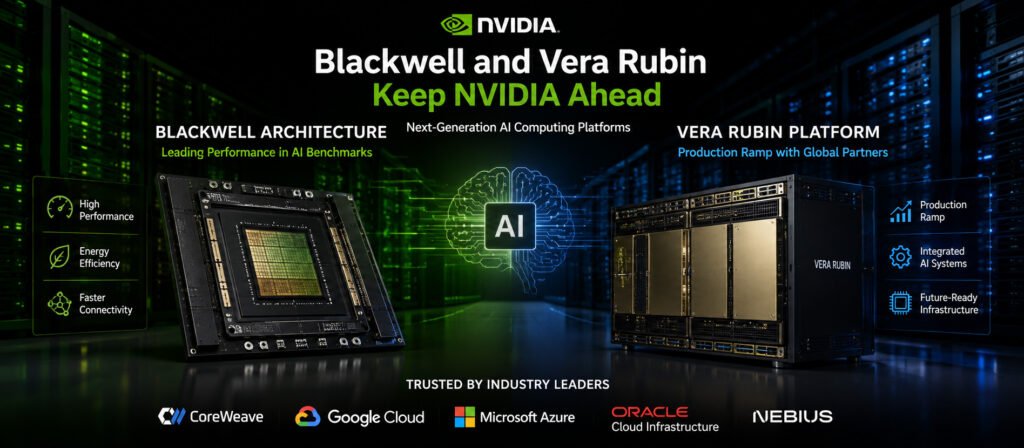
Blackwell and Vera Rubin Keep NVIDIA Ahead
NVIDIA’s advantage is not based on one generation of GPU alone.
The company is building an increasingly broad AI computing platform.
Its latest announcements highlight the continued production ramp of the NVIDIA Vera Rubin platform, with systems running at partners including CoreWeave, Google Cloud, Microsoft Azure, Oracle Cloud Infrastructure and Nebius.
At the same time, NVIDIA says its Blackwell architecture continues to perform strongly in AI benchmarks.
This transition is important because AI infrastructure is evolving rapidly.
Customers want more computing performance, better energy efficiency and faster communication between processors.
NVIDIA is attempting to provide those capabilities as an integrated system rather than selling an isolated chip.
From GPUs to Complete AI Systems
The company’s strategy increasingly resembles a full-stack infrastructure business.
Instead of simply providing GPUs, NVIDIA is combining:
- GPUs
- CPUs
- Networking
- High-speed interconnects
- Software
- AI libraries
- Developer tools
- Cloud partnerships
- Complete data-center systems
This approach creates a deeper relationship between NVIDIA and its customers.
It can also make switching to competing platforms more difficult because customers may build their AI infrastructure around NVIDIA’s broader ecosystem.
AI Infrastructure Is Becoming a Massive Business
One of the biggest lessons from NVIDIA’s latest results is that the AI boom is increasingly an infrastructure story.
Consumers may think about AI through chatbots, image generators or productivity tools.
Behind those applications, however, are massive data centers filled with processors, networking equipment, storage systems and power infrastructure.
That infrastructure is becoming one of the largest technology investment cycles in years.
Reuters reported that major technology companies are expected to spend more than $730 billion on AI infrastructure in 2026, highlighting the scale of the current buildout.
NVIDIA is one of the biggest beneficiaries of that spending.
The AI Factory Concept
NVIDIA is also pushing the idea of an “AI factory” — infrastructure designed specifically to turn computing resources into AI outputs.
The company launched its DSX platform to help infrastructure builders design and operate AI factories at scale.
That strategy could expand NVIDIA’s addressable market beyond individual processors.
If AI becomes a fundamental part of enterprise infrastructure, demand could increasingly move toward complete systems rather than individual components.
NVIDIA’s China Outlook Remains Important
China remains one of the most closely watched issues surrounding NVIDIA.
The company explicitly said its third-quarter outlook assumes no Data Center compute revenue from China.
That does not mean China is irrelevant to NVIDIA.
It means investors have to consider geopolitical and regulatory restrictions separately from the company’s underlying global AI demand.
For U.S. investors, this distinction matters.
NVIDIA can continue reporting strong global growth while simultaneously facing limitations in one of the world’s largest technology markets.
That makes future U.S. export policy, Chinese semiconductor development and NVIDIA’s product strategy in international markets important factors to monitor.
What the Results Mean for NVDA Stock
NVIDIA’s financial results are closely connected to the broader AI trade, which means the earnings report can influence more than just one stock.
The company remains one of the most important publicly traded companies in the technology sector, and its earnings often affect semiconductor stocks and other AI-related companies.
Following the results, NVIDIA shares initially moved lower before recovering and rising in after-hours trading. Reuters reported that the stock eventually climbed about 4.2% after the earnings release.
The reaction highlights something important about today’s market.
Strong results alone may not be enough.
Investors are comparing NVIDIA’s performance against extremely high expectations.
Why Expectations Matter
NVIDIA has delivered extraordinary growth for several years.
That creates a difficult situation for shareholders.
When expectations are already high, even a very strong earnings report can produce a mixed stock-market reaction if investors believe future growth could slow.
The latest quarter appears to have reassured investors that AI infrastructure demand remains strong.
However, the stock’s future performance will depend on whether NVIDIA can continue delivering revenue growth at a scale large enough to justify its valuation.
Rising Costs Could Become a New Challenge
Not every part of the NVIDIA story is straightforwardly positive.
One issue receiving attention after the earnings report is the potential impact of rising memory costs.
NVIDIA’s AI systems require enormous quantities of advanced memory, and stronger demand throughout the AI infrastructure market can place pressure on the supply chain.
Higher component costs can eventually affect gross margins.
The company currently maintains extremely strong margins, but investors are increasingly watching whether those levels can remain sustainable as AI hardware becomes more expensive to produce.
This is an important shift in the NVIDIA story.
Earlier in the AI boom, the primary question was whether NVIDIA could supply enough chips.
Now the industry is also asking how much it will cost to build increasingly powerful AI systems.
NVIDIA’s Expanding Role Beyond GPUs
Another major development is NVIDIA’s expansion into areas beyond traditional GPUs.
The company highlighted its Vera CPU, networking products, AI inference technology and software platforms during the quarter.
It also announced NVIDIA Groq 3 LPX, an inference accelerator designed for interactive AI workloads, and continued expanding its software ecosystem.
This matters because AI computing is changing.
Training is only one part of the market.
As AI applications become widely deployed, inference — the process of running trained models to produce results — could become an enormous source of computing demand.
NVIDIA wants to capture that market as well.
The Bigger Opportunity: AI Everywhere
The long-term opportunity extends beyond large language models.
NVIDIA is also targeting:
- Robotics
- Autonomous vehicles
- Healthcare
- Scientific computing
- Enterprise AI
- Physical AI
- AI agents
- Edge computing
- Gaming
- Industrial applications
Its second-quarter announcements included new robotics platforms, autonomous-driving technology and physical-AI tools.
The strategy is clear.
NVIDIA wants AI computing to become a foundational technology across industries.
What Investors Should Watch Next
The next stage of NVIDIA’s story will depend on several factors.
1. Data Center Growth
The Data Center business is now the company’s primary growth engine.
Investors will want to know whether the 117% year-over-year growth reported in Q2 can remain at elevated levels as NVIDIA’s revenue base becomes larger.
2. Vera Rubin Adoption
The rollout of Vera Rubin will be an important test of NVIDIA’s next-generation platform.
Strong customer adoption could reinforce the company’s position as the preferred supplier for large-scale AI infrastructure.
3. AI Capital Spending
The entire NVIDIA investment thesis depends heavily on continued AI infrastructure spending.
If hyperscalers and enterprises keep increasing their AI budgets, NVIDIA could continue benefiting.
If those companies begin reducing capital expenditure, the growth outlook could change quickly.
4. Gross Margins
NVIDIA’s margins are another major metric.
Higher memory and infrastructure costs could create pressure, while new products could help offset some of those expenses.
5. China and Export Restrictions
Regulatory developments remain a major external risk.
NVIDIA’s current guidance already excludes China Data Center compute revenue, but future policy changes could affect the company’s international opportunity.
6. Competition
NVIDIA is not operating without competition.
Major cloud companies are developing their own AI accelerators, while semiconductor competitors continue targeting the AI market.
NVIDIA’s advantage will increasingly depend on its complete ecosystem rather than simply having the fastest processor.
Key Takeaways
NVIDIA’s second-quarter fiscal 2027 results provide another strong indication that the AI infrastructure boom remains active.
The most important points are:
- NVIDIA generated $96.2 billion in quarterly revenue.
- Revenue increased approximately 106% year over year.
- Data Center revenue reached $89 billion.
- Data Center revenue increased 117% year over year.
- NVIDIA expects approximately $108 billion in Q3 revenue, plus or minus 2%.
- The company’s outlook does not assume Data Center compute revenue from China.
- Blackwell remains central to the current AI infrastructure cycle.
- Vera Rubin is beginning its production ramp.
- AI infrastructure spending remains a major growth driver for NVIDIA.
- Rising memory costs and geopolitical restrictions remain important risks.
- NVIDIA is expanding beyond GPUs into CPUs, networking, inference, robotics and broader AI infrastructure.
Conclusion
NVIDIA’s Q2 FY2027 results show that the AI infrastructure boom is still producing extraordinary numbers.
The company’s $96.2 billion quarterly revenue and $89 billion Data Center business demonstrate how quickly AI computing has become one of the most important areas of global technology spending.
The more interesting question now is not whether AI demand exists.
It clearly does.
The question is how long companies can continue spending at this scale, how quickly new AI infrastructure can generate economic returns and whether NVIDIA can maintain its technological and ecosystem advantage as the industry becomes more competitive.
For now, NVIDIA’s outlook remains aggressive.
The company expects $108 billion in revenue in the third quarter, while continuing to roll out Blackwell and Vera Rubin systems and expanding into AI inference, robotics, autonomous vehicles and physical AI.
That makes NVIDIA’s latest earnings report more than a quarterly financial update.
It is another snapshot of how quickly the global economy is being reorganized around artificial intelligence.
FAQs
What was NVIDIA’s revenue in Q2 fiscal 2027?
NVIDIA reported $96.2 billion in revenue for the second quarter of fiscal 2027, up approximately 106% from the same quarter a year earlier.
How much did NVIDIA’s Data Center business make?
NVIDIA’s Data Center revenue reached $89.0 billion, representing 117% year-over-year growth and 18% sequential growth.
What is NVIDIA’s Q3 FY2027 revenue forecast?
NVIDIA expects third-quarter fiscal 2027 revenue of $108 billion, plus or minus 2%. The company said its outlook assumes no Data Center compute revenue from China.
What is driving NVIDIA’s revenue growth?
The primary driver is demand for AI infrastructure, particularly Data Center computing. NVIDIA is supplying GPUs, networking, CPUs, software and complete systems used to build and operate large-scale AI infrastructure.
Is NVIDIA still focused mainly on GPUs?
GPUs remain central to NVIDIA’s business, but the company is expanding into CPUs, networking, AI inference, robotics, autonomous vehicles, software and complete AI infrastructure platforms.
Why is NVIDIA important to the AI market?
NVIDIA supplies much of the computing infrastructure used to train and operate advanced AI systems. Its performance is therefore closely watched as an indicator of broader AI infrastructure demand.
What are the biggest risks for NVIDIA?
Important risks include high market expectations, rising memory and component costs, competition from custom AI chips, geopolitical restrictions and uncertainty around future AI infrastructure spending.
What is Vera Rubin?
Vera Rubin is NVIDIA’s next-generation AI computing platform. NVIDIA said the platform is ramping into full production, with systems running at several major infrastructure partners.
Did NVIDIA’s stock rise after the earnings report?
NVIDIA shares initially moved lower following the results before recovering. Reuters reported that the stock eventually rose about 4.2% in after-hours trading.
Why does NVIDIA’s earnings report matter to U.S. investors?
NVIDIA has become a major indicator of AI and semiconductor spending. Its results can influence investor expectations for cloud companies, semiconductor manufacturers and other businesses connected to artificial intelligence.
Other Articles


No Comment! Be the first one.